
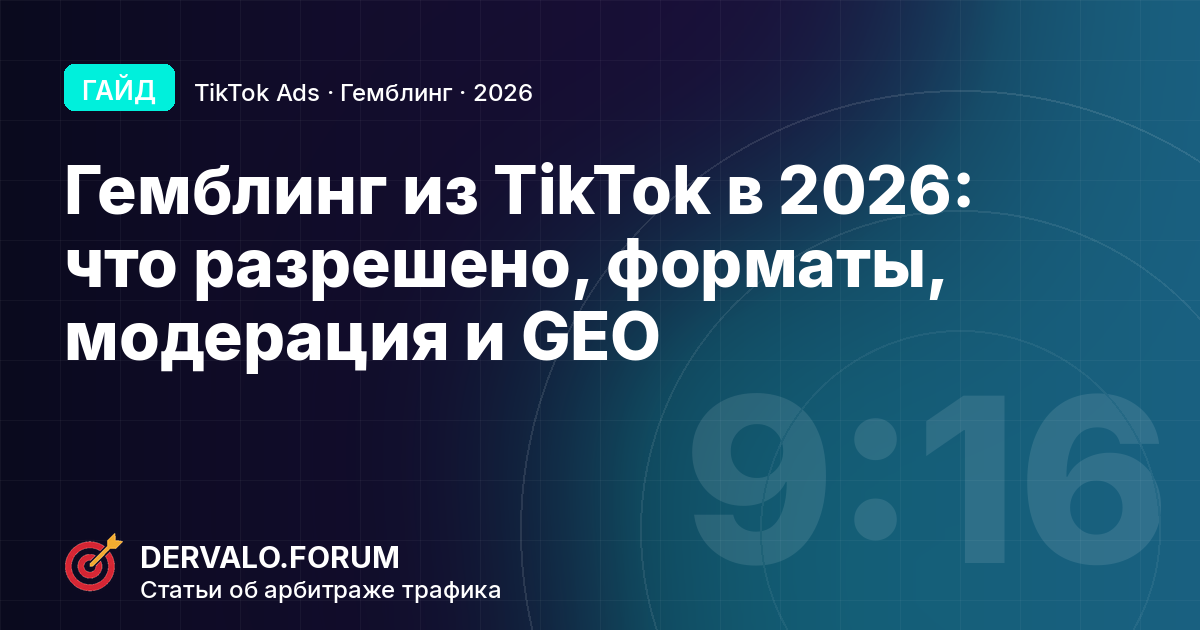
TikTok has been the fastest-growing gambling traffic source of the past three years and the most contradictory one: half of the "case studies" online describe funnels that died within a week, the other half are service ads. This guide covers how gambling traffic from TikTok actually works: what the platform officially allows, how paid and organic traffic differ, which creatives pass and why, how to calculate FTD economics, and in which countries TikTok even exists. No "secret schemes" — only what can be verified.
What TikTok Allows: Rules, Not Rumours
Start with what most people skip. TikTok Ads policy treats gambling as a restricted category: casino, betting and lottery ads are allowed only in specific countries, only for licensed operators, and only after separate account approval. TikTok updates the country list and requirements periodically — the current version is always in the Industry Entry Policy section of the ad platform.
In practice this means three things. First: white-hat gambling on TikTok Ads is advertising a licensed brand in a permitted country through an approved account, usually an agency one. Second: anything outside that list is a violation from the platform's point of view, and an account running it lives exactly until the first review. Third: a large share of gambling traffic from TikTok does not go through the ad platform at all but through organic content — a separate world with its own rules.
Understanding this fork saves more money than any "funnel": half of beginner failures are attempts to run a grey offer through a regular ad account and surprise when it gets banned on day three.
Two Paths: TikTok Ads and Organic (UBT)
| Parameter | TikTok Ads (paid) | Organic / UBT |
|---|---|---|
| How it works | Campaigns in Ads Manager: In-Feed, Spark Ads, TopView | Content accounts, traffic from recommendations, link in bio or comments |
| Scale | Limited by budget and account limits | Limited by number of accounts and the algorithm |
| Speed | Results in hours | Results in days to weeks, unpredictable |
| Moderation | Every ad and landing page | Content and account as a whole, after the fact |
| Costs | Budget + agency account + creatives | Accounts, proxies, devices, time on content |
| Best for | Teams with budget and licensed offers | Solo and small teams ready for manual work |
Organic traffic will get its own guide — here we focus on paid, because that is where most money mistakes happen.
Accounts: What TikTok Ads Will Not Launch Without
A regular self-serve TikTok Ads account is not suited for gambling — the category requires an approval that self-serve does not get. The working option is an agency account from a TikTok partner with the gambling category open for the required countries. Such accounts are issued by agencies, some of which are in the agency accounts catalog; how they work, fees and pitfalls — in the agency accounts guide. TikTok's logic is the same as Meta's: limits and trust belong to the agency.
What to ask the agency before depositing: in which countries exactly gambling is open, whether an operator certificate is required (often yes — and the network provides it), what happens on a ban and whether the balance carries over. Answers like "everything, everywhere" are a warning sign: TikTok does not open gambling "everywhere" for anyone.
Offers and Models: What to Calculate Before Launch
Gambling pays for FTD — the first deposit, less often for registration with KPIs. On CPA the FTD rate ranges from tens to hundreds of dollars depending on GEO and brand; on RevShare it is a share of player losses. What to choose for TikTok depends on traffic quality: TikTok delivers many cheap registrations and noticeably fewer deposits than search, so networks often set a baseline for TikTok — a minimum deposit or activity threshold below which payouts are cut.
Before launch you need four numbers: the FTD rate, the network's baseline, the average click-to-registration CR and registration-to-deposit CR for that GEO. Without the last two, a test budget is a lottery. How FTD, baseline and NGR are calculated and where the traps are — in The Gambling Vertical in 2026; model comparison — in CPA, RevShare and Hybrid. Gambling networks with terms and reviews — in the catalog.
GEO: Where TikTok Exists and Where It Does Not
The first thing to check is whether TikTok exists in the country at all. India blocked the app in 2020: "hot Indian TikTok funnels" are either old cases or a different source under the same name. In the US, TikTok's status changed in 2024–2025 due to the divestiture law; check the current state before launching on US. In several countries the app is restricted or unavailable.
Where TikTok is traditionally a strong gambling source: Latin America (Brazil, Mexico, Chile, Peru, Colombia), Southeast Asia (Indonesia, Philippines, Vietnam, Thailand), Turkey, parts of Africa (Nigeria, Kenya), Eastern Europe. The common trait — a young mobile audience, cheap CPM and networks with local payment methods. From there the choice comes down to two things: whether gambling is open on TikTok Ads for that country via your agency, and whether the network has an offer with local deposit methods — without them a registration never becomes an FTD.
Creatives: What Passes and What Converts
TikTok is 9:16 vertical video, and the decision to watch is made in the first 1–3 seconds. That dictates the format: no intros, no logos at the start, action immediately. What works consistently year after year:
- Slot and crash gameplay. Screen recording of real play, a live voice or face reaction, no edited "million-dollar wins".
- UGC format. A person talking to camera as a user, not as an ad. Spark Ads — promoting an organic post from an account — gives this format extra trust.
- Localisation. Language, currency, recognisable payment methods in frame. A creative translated from English loses to one shot for the country.
- First frames built for sound. TikTok is watched with sound on — tone and track matter more than on Meta.
What consistently leads to rejection or a ban: promises of guaranteed wins, showing specific amounts as "income", implying the game is a way to earn, using minors or people who look like minors, third-party brands and celebrities, missing age labels where required. All of this comes from TikTok's public policies, not from any team's practice.
Moderation: Why Ads Get Rejected and How to Live With It
TikTok reviews the ad, the destination page and the account. The main gambling rejection reasons: category not open for the country, no approval, landing page does not match the ad, elements from the list above. A separate reason people forget — ad text and audio: moderation listens to sound and reads captions.
The rules of conduct are the same as with Meta: do not resubmit the same rejected creative, do not scale abruptly, do not move assets from banned accounts. Account trust mechanics and "inherited" bans are described in the trust guide — they are platform-independent.
Tracking: How Not to Lose FTDs on the Way
TikTok has a pixel and Events API — server-side event delivery. For gambling the server channel is critical: a registration is still visible to the pixel, but the deposit happens inside the network's product and never reaches the pixel. The standard scheme: click from TikTok → tracker with clickid → offer with a parameter → the network sends a postback with the event (registration, FTD) → the tracker sends the event to TikTok via Events API. Without this, TikTok's algorithm optimises for registrations and floods you with junk.
Separately: TikTok passes its own macros in the URL (campaign, ad group and ad IDs) — they must be forwarded to the tracker to see which creative produces FTDs rather than just clicks. How to set up a postback and what to do when it does not arrive — in Postbacks and S2S and Postback Not Firing.
Test Economics: How Much to Budget
The honest answer — it depends on GEO and rate, but there is logic. To get a statistically meaningful result you need at least 5–10 FTDs per funnel. At a 10–20% registration-to-deposit CR that is 50–100 registrations; at a 15–30% click-to-registration CR — 300–600 clicks. Then multiply by your CPC for the GEO. Also budget for the first account possibly getting banned before break-even — that is part of the cost, not force majeure. How to calculate the break-even point — in Affiliate Math.
The conversion figures above are reference points for estimating budget scale, not benchmarks. Real values for a specific offer come from the network, and asking for them before launch is normal.
PWA and Apps: Why They Appear in TikTok Funnels
Part of gambling traffic from TikTok leads not to a site but to an app or PWA — an install with subsequent pushes lets you re-engage a user who did not deposit right away. For paid traffic this is a separate story with its own moderation and stores; for organic — a way to retain the audience without relying on a single link in bio. PWA services overview — in the catalog, the approach — in PWA in Affiliate Marketing.
Typical Mistakes
- Launching a grey offer from a self-serve account and expecting it to "slip through".
- Creatives translated from English for LatAm or Asia.
- Optimising for registrations without server-side FTD events.
- Choosing an offer by rate rather than by baseline and local payment methods.
- Scaling sharply after the first deposits — and a ban on day two.
- Believing in "Indian TikTok funnels" while the app is blocked in India.
Forum Discussion
TikTok's rules and open GEOs change more often than Meta's, and the freshest data belongs to those running traffic right now. What is open, which creatives pass this week, who has which baselines — discuss in the social networks section of the forum. On the myths around the platform — a separate article.
Frequently Asked Questions
Can you advertise casinos on TikTok?
Only licensed operators in specific countries and after account approval. For an affiliate that means an agency account with the gambling category open and a licensed brand's offer for a permitted GEO. Everything else violates platform rules.
What is organic (UBT) traffic on TikTok?
Conditionally free traffic: content accounts that gain views from recommendations, and clicks via link in bio or comments. Only the click is free — accounts, proxies, devices and time on content cost money.
Which GEOs are best for gambling from TikTok?
Traditionally strong: Latin America, Southeast Asia, Turkey, parts of Africa and Eastern Europe — young mobile audiences and cheap CPM. India is out: TikTok has been blocked there since 2020. The specific choice depends on where gambling is open via your agency and whether the network has local payment methods.
Why does TikTok reject gambling creatives?
Category not open for the country, no approval, landing page mismatch, promises of wins, "income" amounts, minors, third-party brands or missing age labels in the creative. Moderation checks audio too.
How do you pass FTDs to TikTok?
Via Events API — server-side event delivery. The network's postback with the deposit event reaches the tracker, and the tracker sends the event to TikTok by clickid. Without it, the algorithm optimises only for registrations.
How much does a gambling funnel test on TikTok cost?
There is no single figure: you need 5–10 FTDs per funnel, which is 300–600 clicks at typical conversion rates, multiplied by the GEO's CPC, plus a reserve for a possible ban of the first account. Exact offer conversion rates are best requested from the network before launch.
Do you need a PWA for TikTok traffic?
Not required, but useful: an install and pushes let you bring back a user who did not deposit immediately. For paid traffic it is separate moderation, for organic — a way not to depend on a single link in bio.