



Neurocommenting in Telegram is one of the most talked-about ways to promote channels: an AI writes comments under posts in other people's channels, and readers click the commenter's profile and end up in your channel or on your offer. Sellers promise subscribers for a few cents; affiliates argue whether it actually works. Here is an honest breakdown: what neurocommenting is, how it works, services and prices, the results people claim and the risks for your accounts and reputation.
Quick summary
- What it is: automated AI-generated comments under Telegram channel posts, posted from regular user accounts.
- Why: to catch the attention of another channel's audience and bring it to your channel, bot or offer.
- Cost: from $25/month for a simple script to $300–600/month for done-for-you services.
- Main risks: account bans, bans by channel admins, audience fatigue and reputation damage.
- Verdict: risky and unstable — not suitable as a primary traffic source.
What is neurocommenting
Neurocommenting is the automated posting of AI-written comments under Telegram channel posts. Comments come not from bots but from ordinary user accounts with an avatar, a name and a profile bio that links to a channel or product. Under a popular post, thousands of people read the comments; if yours is early and on-topic, some readers tap the avatar and follow the link. In effect it is free, unauthorized cross-promotion. A related tactic, neurochatting, uses AI accounts to hold conversations in group chats.
How neurocommenting works
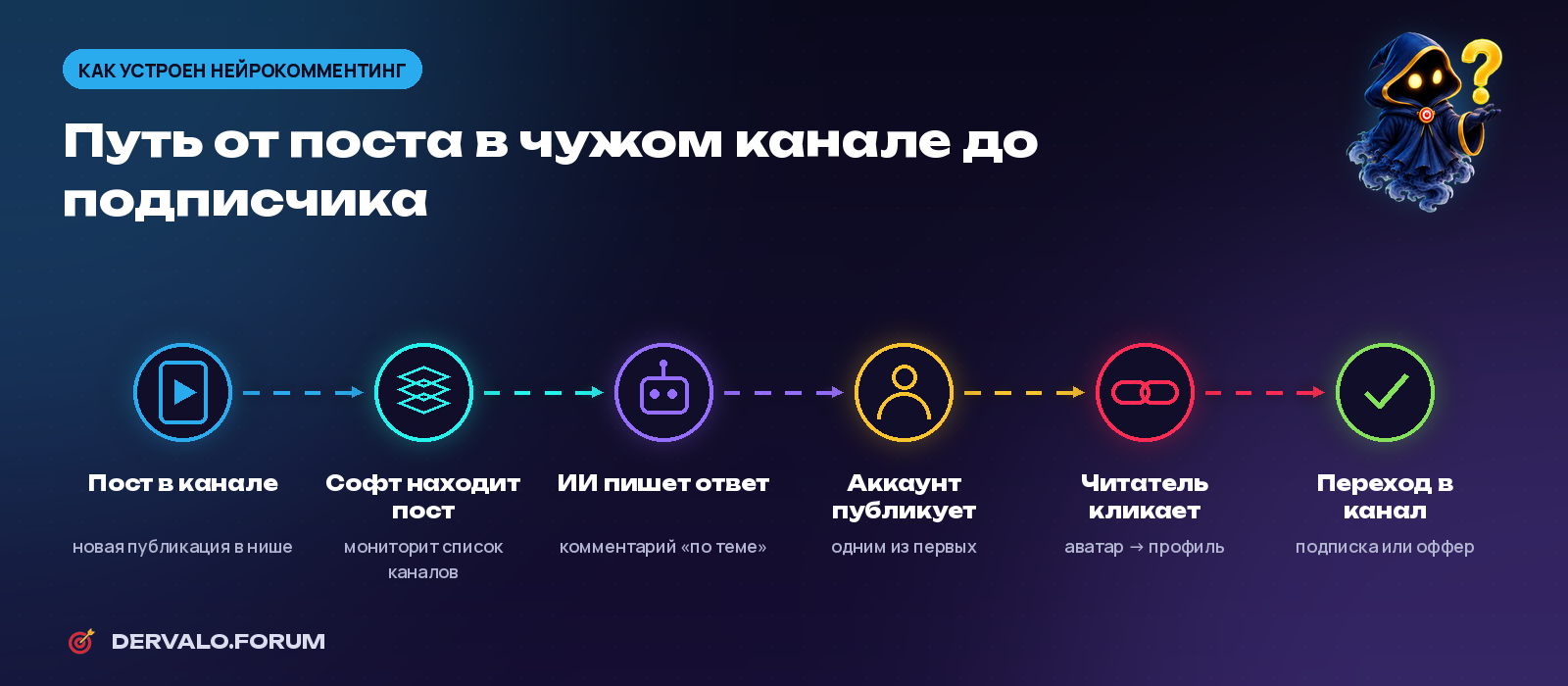
From a new post in someone else's channel to a subscriber (chart labels in Russian)
The software monitors a list of niche channels, sends each new post to an AI model that writes a short on-topic comment, and publishes it from a user account whose profile links to your channel. It requires user accounts, a separate proxy per account and a channel list that typically needs refreshing every 3–4 weeks as audiences stop reacting.
Services and prices
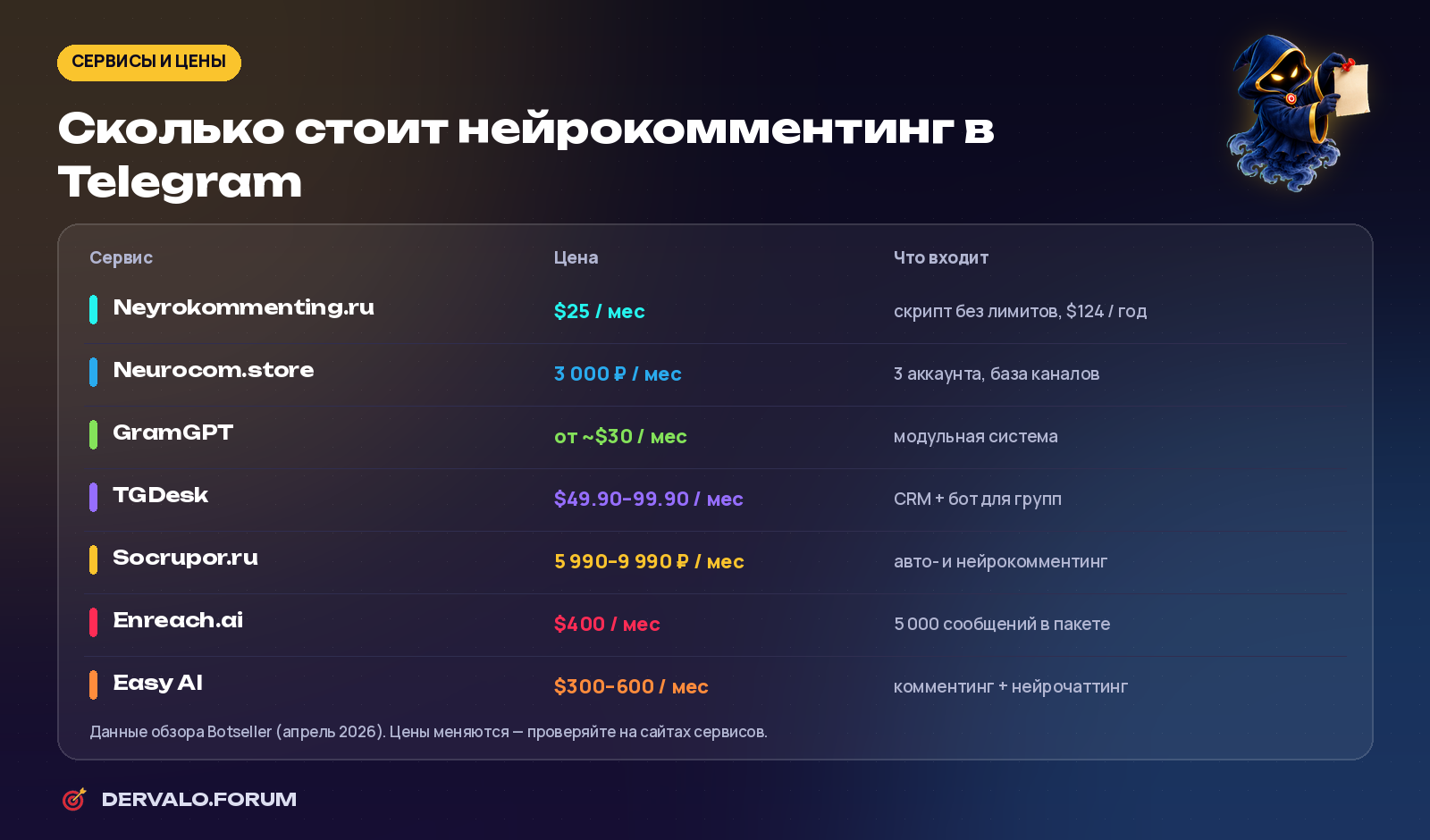
Prices per Botseller's review, April 2026 (chart labels in Russian)
Options range from DIY scripts (Neyrokommenting.ru, $25/month) and services with accounts and channel databases (Neurocom.store, about 3,000 RUB/month for 3 accounts) to done-for-you packages such as Easy AI ($300–600/month) and Enreach.ai ($400/month). Prices change fast — check vendor sites before buying.
Claimed results vs reality
Vendors cite subscribers at 8–25 RUB versus 200–300 RUB for traditional channel ads, and 10–20 subscribers per account per day. These are vendor and client claims, not independent research. Cheap subscribers from a random comment tend to engage less, unsubscribe more and buy less than subscribers from targeted paid placements. Measure cost per action and return on spend, not cost per subscriber.
Where neurocommenting is used
Mostly in niches with lively discussions under posts: finance, crypto, affiliate marketing, media and news, info products and expert services.
How to check if it pays off
Count the full cost, not just the software. Example: a 3,000 RUB/month service plus 4,000 RUB for accounts and proxies is 7,000 RUB. If you get 250 subscribers, each costs 28 RUB — but if only 3 of them buy with a 1,500 RUB margin, revenue is 4,500 RUB and the test loses money; 8 buyers would make it profitable. Compare ROI with paid placements and budget for losing accounts.
Risks
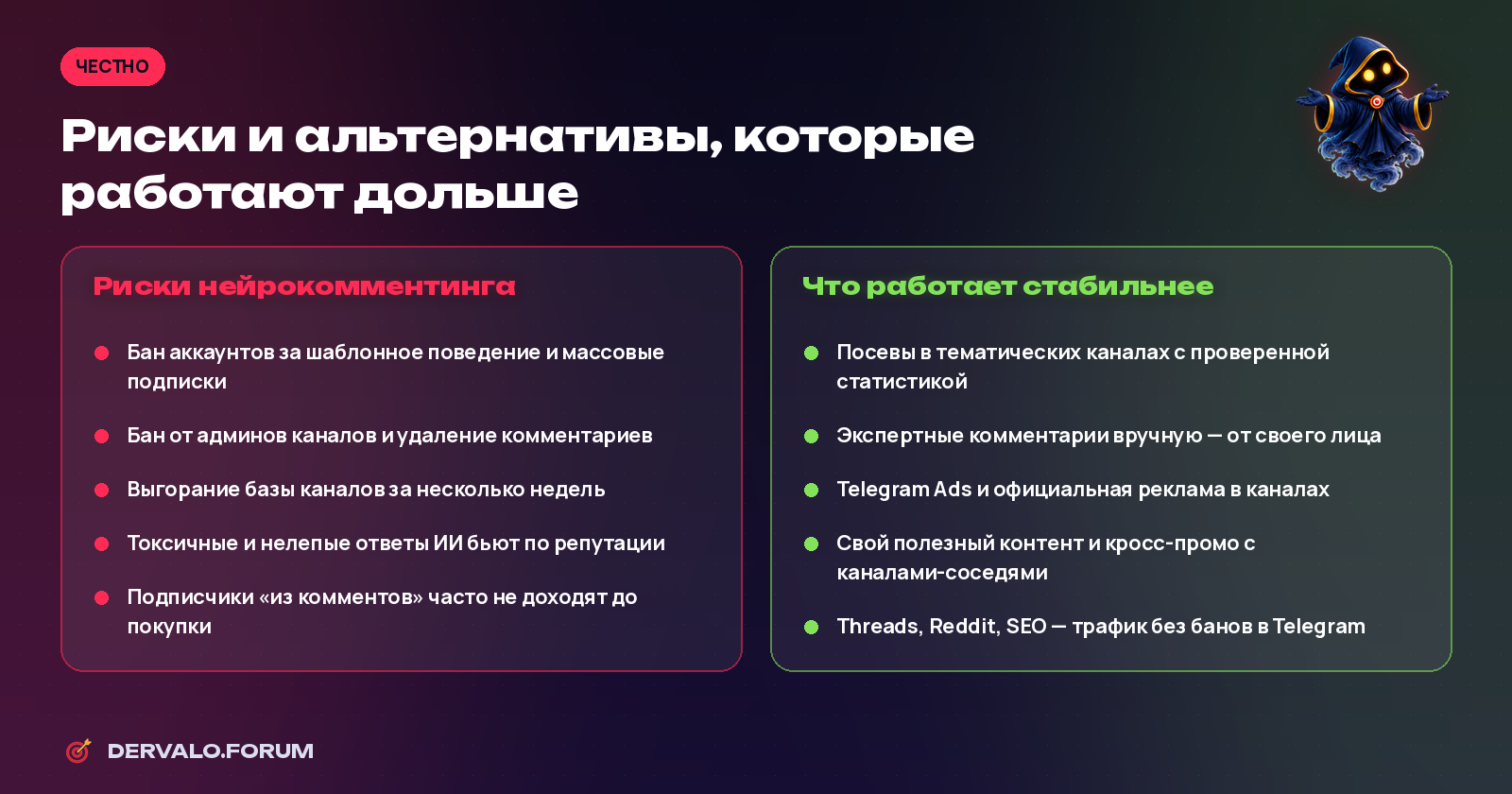
Risks and more stable alternatives (chart labels in Russian)
- Account bans: Telegram fights spam and unnatural activity; repetitive comments and mass subscriptions lead to restrictions and deletions.
- Admin bans: channel owners delete such comments, block accounts and close discussions.
- Audience fatigue: the same channels stop converting within weeks.
- Reputation: clumsy or toxic AI replies are seen by thousands and tied to your brand.
- Platform rules: mass unsolicited messaging violates Telegram's terms.
How channel owners can protect themselves
Allow comments only from discussion group members and approve join requests, enable aggressive anti-spam and slow mode, use moderators or a moderation bot, and close comments on specific posts when needed.
What works better
- Paid placements in niche channels — see buying ads in Telegram channels.
- Telegram Ads — see Telegram Ads for affiliates.
- Genuine expert comments under your own name.
- Cross-promotion with neighbouring channels and useful content of your own.
- Other sources: Threads, Reddit, SEO and Telegram Mini Apps.
Is neurocommenting worth it for affiliates?
It can deliver quick, cheap subscriber growth, but it is an unstable traffic source with a high ban risk and weak audience quality. If you test it, measure revenue rather than subscriber cost, budget for losing accounts and never use your main account or brand. Share your experience on the DERVALO forum.
FAQ
What is neurocommenting in simple terms?
AI automatically writing comments under posts in other Telegram channels from user accounts, to draw readers to your channel or offer.
How much does neurocommenting cost?
From about $25/month for a script to $300–600/month for managed services, plus accounts and proxies.
Does Telegram ban accounts for neurocommenting?
Yes — accounts with repetitive mass activity get restricted or deleted, and channel admins block them too.
What is better than neurocommenting?
Paid placements in niche channels, Telegram Ads, genuine expert comments, cross-promotion and your own content.
Sources: Botseller, Partnerkin, ADPASS.