


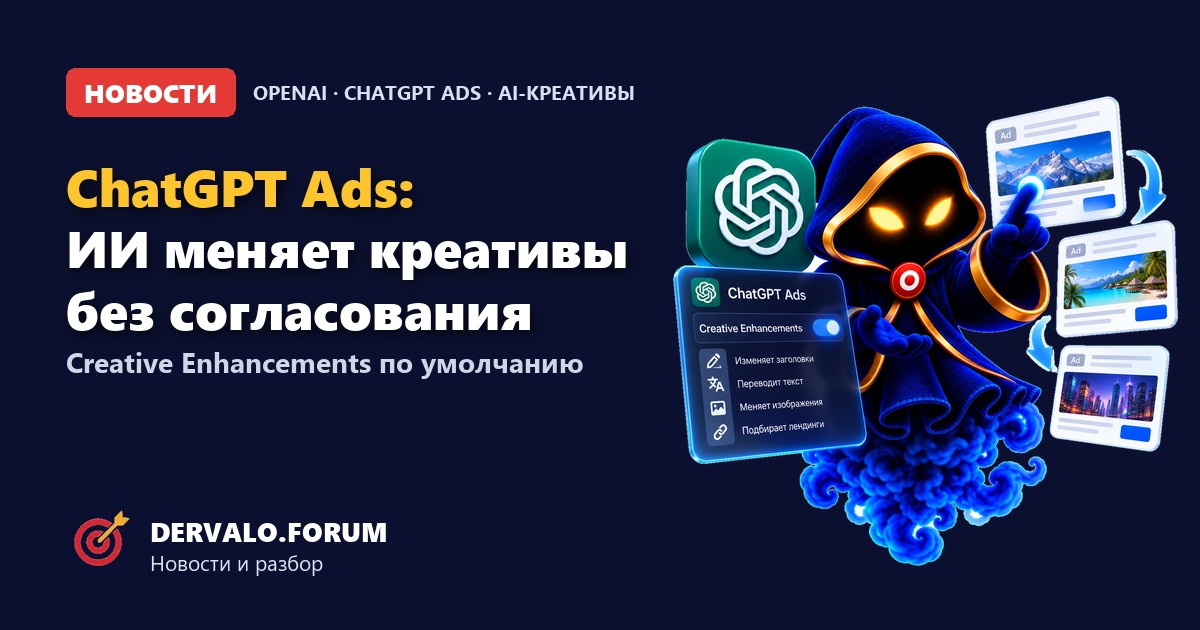
OpenAI is turning on Creative Enhancements in ChatGPT Ads by default. The system can rewrite headlines and descriptions, translate ads into other languages, resize images and send users to a different page on the advertiser's site. Each variation does not need advertiser approval: enhanced creatives can go live automatically.
For media buyers this cuts both ways. There is less manual work on language and segment variations, but also less control over the copy, the claims and the page a user ultimately lands on. Here is what changes, when the feature turns on, how to opt out and what to check before launch.
- What: Creative Enhancements in ChatGPT Ads.
- Who is affected: new and existing self-serve campaigns.
- Main risk: creatives change without prior review or approval.
- Control: opt out at the account or campaign level in Ads Manager.
What are Creative Enhancements in ChatGPT Ads?
Creative Enhancements sit on top of a standard ad. OpenAI takes the existing creative and landing-page content, adds the context of the user's conversation with ChatGPT and their interests, then adapts the ad to that situation. The goal is to make advertising more relevant and save advertisers from manually building dozens of versions.
Variations can be prepared in advance or generated in real time for a specific conversation. When the feature is on, enhanced ads can run without review or approval of each version. There is also no way to preview every variation, as OpenAI states directly in its help center.
What the system can change
| Element | What changes | What it means for a media buyer |
|---|---|---|
| Headlines and descriptions | New copy tailored to the conversation or user interests | Wording and claims may differ from the original creative |
| Language | The ad text may be translated | Language versions appear that you did not write by hand |
| Images | Images may be resized for the ad format | The crop may differ from the original asset |
| Destination URL | The link may be optimized | A user may land on a different page of your site |
In OpenAI's own example, an ad for “Fresh groceries delivered” becomes “Groceries for quick weeknight dinners” in a conversation about fast meals. The product and delivery are the same, but the emphasis shifts to fit the context. That is the intent: adapt the presentation, not substitute the offer.
How it works
OpenAI lists three inputs: the context of the conversation or user interests, the existing ad, and the content of the landing page. Based on them, the system can rewrite copy, translate it, resize an image or choose a more relevant page on the advertiser's site.
The practical takeaway: the quality of the “enhancements” depends on what your landing page says. If it shows an outdated price, a discontinued product or contradictory terms, the model may carry that into the ad. OpenAI specifically recommends keeping prices, promotions, product details and availability current.
When it turns on and how to opt out
The dates in the sources differ. OpenAI's help center says October 31, 2026, the email to advertisers says October 30, and some publications report October 29. The gap may come from time zones and documentation updates, so check the setting in your own account: the feature is being enabled for new and existing self-serve campaigns.
You can opt out in Ads Manager at the account or campaign level. Campaign-specific settings take priority over the account default. Existing account- and campaign-level opt-outs are preserved.
- Open Ads Manager and go to account settings.
- Find the Creative Enhancements section.
- Turn the feature off for the account or for specific campaigns.
- Confirm that the setting applies to live campaigns, not just new ones.
What it means for affiliate media buying
Upside. Less time spent adapting creatives for different languages and segments. More copy variations for the conversation context. Easier testing of new audiences without manually building dozens of ads.
Downside. You lose control over the wording. The model may amplify a claim you cannot deliver or pick a page without the intended offer. For sensitive verticals — finance, health, gambling, crypto — that adds compliance risk.
Check analytics as well. If the destination URL is optimized, some traffic may go to other pages. Make sure UTM tags, pixels and postbacks still work and that reporting shows which ad variation produced a conversion. OpenAI warns that metric changes over time do not on their own prove the effect of Creative Enhancements; you need a proper test.
Pre-launch checklist
- Are prices, promotions, terms and stock levels current on the landing page?
- Do the creative and the landing page promise the same thing?
- Are there pages on the site that must not appear in ads?
- Do UTMs, pixels and postbacks survive a destination URL change?
- Are there sensitive claims in the campaign that must not be rewritten automatically?
- Who reviews new variations, and how often?
- Should the feature be off for brand and regulated campaigns?
FAQ
What are Creative Enhancements in ChatGPT Ads?
A feature that adapts an ad to the conversation context and user interests: it rewrites headlines and descriptions, translates text, resizes images and optimizes the destination URL.
When are Creative Enhancements enabled by default?
OpenAI's email says October 30, 2026, the help center says October 31, and some publications report October 29. Check the exact date and status in your Ads Manager.
Can I preview every ad variation before it runs?
No. OpenAI states that you do not need to approve each version and that the experience does not provide a preview of every variation. Enabled enhancements can run automatically.
How do I opt out of Creative Enhancements?
In Ads Manager at the account or campaign level. Campaign settings override the account default, and existing opt-outs are preserved.
Do ads affect ChatGPT's answers?
No. According to OpenAI, ads do not influence ChatGPT's answers and are clearly labeled.
What data does the system use?
The existing ad, landing-page content, and conversation context or user interests.
What happens to images?
OpenAI may resize images to fit the ad format. Check how the creative looks in different ratios and whether the key element survives the crop.
Who should turn it off?
Advertisers with strict wording requirements, regulated verticals, brand campaigns and landing pages with sensitive terms. If the creative is simple and compliant, it can be tested with the feature on.
How should I measure the impact?
Watch impressions, clicks, spend, CTR and conversions in Ads Manager, but compare comparable periods and campaigns. Changes over time alone do not prove the effect of the enhancements.
Sources
Official help center: Creative enhancements for ChatGPT Ads. Advertiser email and timeline: Search Engine Roundtable. Practical breakdown: Adthena. On our site: an AI creative factory and a guide to ad creatives.