




RevShare (Revenue Share) is an affiliate payment model in which the program pays the webmaster a percentage of the revenue generated by the players or customers they referred. Not once per deposit, as with CPA, but every month while the user stays active. Below: what RevShare means in plain words, what amount the percentage is actually based on, how to calculate profit with real numbers, and when revenue share beats CPA and when it does not.
What RevShare Means in Plain Words
RevShare stands for Revenue Share. You bring a user, the advertiser earns from them and gives you an agreed share. If a casino player keeps playing for two years, you earn a percentage for two years. If they stop after a week, payouts stop after a week.
The key difference from CPA: with CPA you get a fixed amount once (for example, $100 per first deposit), with RevShare you get a percentage of the business's revenue for the customer's whole lifetime. That is why revenue share is called a "passive income" model and a bet on LTV (Lifetime Value, how much a user brings over their lifetime).
The model exists in many verticals, but it became the standard in gambling and betting. Market rates range from 25 to 70 %. In our catalog, for example, iWildPartners and RioAff advertise RevShare up to 70 %, Cake Partners up to 60 %, and Megapartners up to 50 %.
How RevShare Works: What the Percentage Is Based On
The most common beginner mistake is thinking 40 % revenue share means 40 % of the deposit. If a player deposits $100, you do not get $40. The percentage is calculated from the advertiser's net revenue, NGR (Net Gaming Revenue), after winnings, bonuses and costs are deducted.
- Deposits: how much players deposited during the period.
- GGR (Gross Gaming Revenue): deposits minus the winnings players withdrew. The casino's gross revenue.
- NGR (Net Gaming Revenue): GGR minus bonuses, free spins, cashback and Admin Fee. Your share is usually calculated from NGR.
The basic iGaming formula:
(Deposits − Winnings − Bonuses − Admin Fee) × RevShare rate = your payout
Profit Calculation: A Worked Example
A hypothetical example: you referred 100 players who deposited $20,000 in the first month. RevShare rate is 40 %, Admin Fee is 20 %.
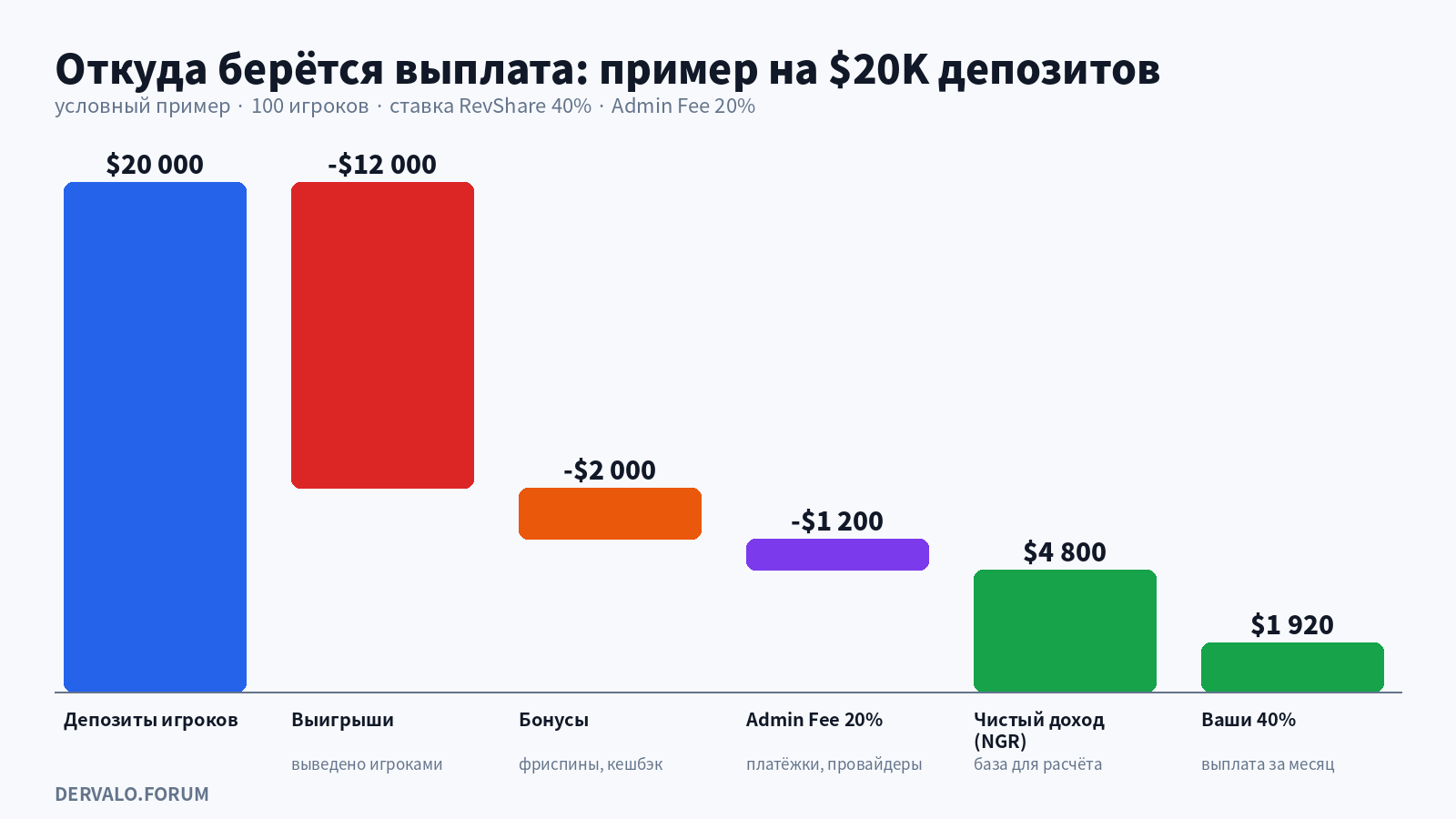
Of $20,000 in deposits, $1,920 reaches the affiliate · click to enlarge
- Deposits: $20,000.
- Players won and withdrew $12,000 → GGR = $8,000.
- Bonuses and free spins: −$2,000 → $6,000.
- Admin Fee of 20 % of $6,000: −$1,200 → NGR = $4,800.
- Your 40 % of NGR: $1,920 for the month.
Bottom line: at a "40 %" rate you receive about 10 % of deposits. That is normal; it is how the model works. Comparing RevShare and CPA by rate makes no sense; compare total income over a period.
What Admin Fee Is
Admin Fee is the part of the advertiser's costs passed on to the affiliate: payment processing fees, game provider royalties, gambling taxes in some jurisdictions. Its size and base (GGR or NGR) are set in the program terms and differ noticeably between programs. Some programs charge no Admin Fee at all, which at the same rate means noticeably higher income.
How Bonuses Are Counted
Bonuses, free spins and cashback given to players are almost always deducted from the base. The more aggressive a brand's bonus policy, the lower the NGR and your share. So when choosing an offer, look not only at the rate but also at how the brand handles bonuses.
Negative Carryover and NNCO: What Happens When a Player Wins
With RevShare you share not only profits but also losses with the casino. If a player hits a big win and cashes out, the month's NGR goes negative, and so does your balance.
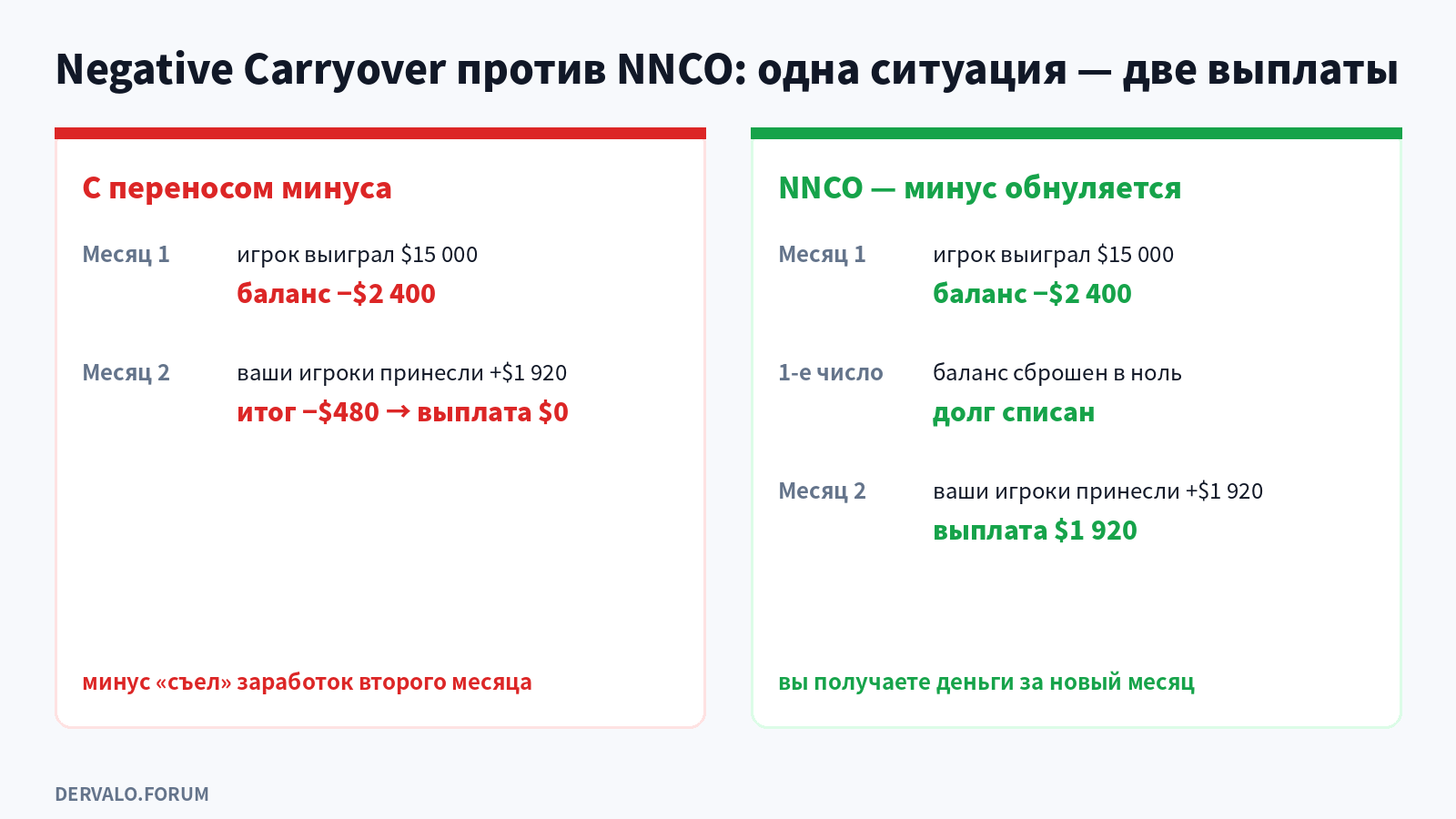
The same situation, a different payout depending on the terms · click to enlarge
- Negative Carryover: the negative balance moves to the next month. Until new players cover it, there are no payouts.
- NNCO (No Negative Carryover): the negative balance resets at the start of each month, and you start fresh.
Example: a player wins $15,000, the month's NGR is −$6,000, and your balance at 40 % is −$2,400. In month two your players bring +$1,920. With carryover the total is −$480 and the payout is $0. With NNCO the payout is $1,920. The condition should be stated in the offer rules; if it is not, assume the negative carries over.
Note: a negative balance is not a debt. You never repay the program out of pocket; you simply receive no payouts until the balance turns positive.
RevShare vs CPA vs Hybrid
| CPA | RevShare | Hybrid | |
|---|---|---|---|
| What you are paid for | a fixed amount per action (deposit, registration) | a percentage of net revenue per player | a fixed amount per deposit + a reduced percentage |
| When you get paid | after the hold, right away | monthly while the player is active | part now, part over the player's lifetime |
| Payback | fast | from a few months to a year | medium |
| Negative balance risk | none | yes (big wins) | on the percentage part |
| Traffic requirements | first-deposit KPIs | retention and player value | both |
| Best for | paid traffic: FB, TikTok, UAC, push | SEO, ASO, Telegram, streamers, own base | buyers who want a long tail without a cash gap |
RevShare or CPA: Payback Calculation
Continuing the example: 100 first deposits, with the alternative of CPA at $100 per FTD, i.e. $10,000 upfront. On RevShare, first-month income is $1,920, and after that it depends on retention: the share of revenue kept from month to month.
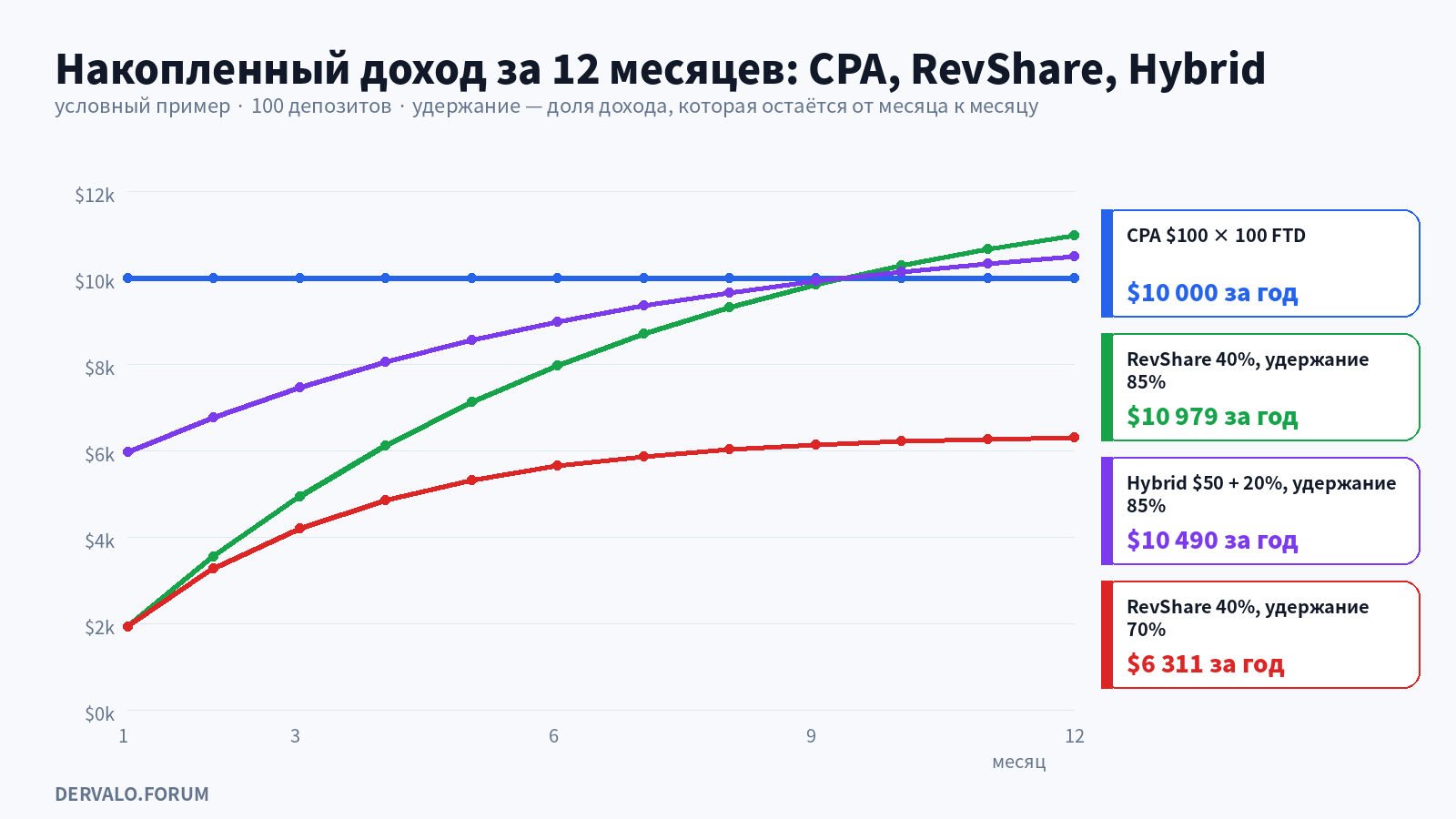
With poor retention RevShare never catches up with CPA within a year · click to enlarge
- 85 % retention: RevShare catches up with CPA in month 10, gives $10,979 for the year and keeps earning after that.
- 70 % retention: only $6,311 for the year. Players leave quickly, and CPA pays almost twice as much.
- Hybrid $50 + 20 %: $5,000 upfront covers part of the traffic cost; $10,490 for the year.
A quick estimate without charts: total future RevShare income ≈ first-month income ÷ (1 − retention). At $1,920 and 85 % retention that is $12,800, more than $10,000 on CPA. At 70 % retention it is $6,400, less. If your traffic loses more than 20 % of revenue per month, CPA wins in this example.
The numbers are hypothetical: retention and revenue per player depend heavily on GEO, brand and source. You learn your real retention by testing, for example on Hybrid, tracking a player cohort's monthly revenue in the program dashboard.
Types of RevShare
- Flat: one rate for all traffic, e.g. 40 %.
- Tiered: the rate grows with monthly first deposits, say 25 % up to 10 FTD and 45 % from 50 FTD.
- Lifetime: paid while the player is active. Some programs limit the attribution period (e.g. 12–24 months); check in advance.
- Hybrid: a fixed payout per deposit plus a reduced percentage.
- Sub-affiliate: a percentage of the revenue of webmasters you referred to the program (usually 3–5 %).
Where RevShare Is Used
- Gambling and betting: a percentage of casino or sportsbook NGR. The main revenue share niche; programs are listed in our gambling affiliate catalog.
- Crypto and trading: a percentage of exchange or broker trading fees.
- Subscriptions: dating, VPN, SaaS; a percentage of every renewal.
- Finance: a share of revenue from referred customers.
Which Traffic Suits RevShare
Revenue share pays off when players stay for a long time. So it works best with organic and loyal audiences: SEO sites and review sites, ASO, Telegram channels and streams, email and push bases. Users come on their own with existing intent and play longer.
Paid traffic (Facebook, TikTok, UAC) is harder: you pay for clicks now, while revenue share income arrives over months, and without a financial cushion you hit a cash gap. Social media buyers more often work on CPA or Hybrid and move part of their proven traffic to RevShare. More on media buying in our articles on UBT traffic from TikTok and PWA in affiliate marketing.
Incentivized traffic and misleading ads make no sense on RevShare: such users never become regular players, and income will be close to zero.
Pros and Cons of RevShare
Pros:
- income continues after traffic stops, while players stay active;
- a high ceiling: a quality player brings more in a year than any CPA rate;
- no strict early KPIs and no "rejected for quality" risk;
- the player base accumulates and works like an asset.
Cons:
- slow payback and a need for working capital;
- negative balance risk from big wins;
- income depends on advertiser stats that are hard to verify;
- if the brand closes or changes terms, the passive income is gone.
Risks: Shaving, Player Unlinking and Brand Closure
On RevShare you only see the stats the advertiser shows. Hence the risks:
- Shaving: underreporting revenue or hiding some players. It is harder to spot on revenue share than on CPA.
- High roller unlinking: big players get "unlinked" from your account under the pretext of rule violations.
- Changing terms: a higher Admin Fee or a lower rate applied retroactively.
- Casino closure or rebranding: attributed players disappear together with the income.
How to reduce risk: work with direct advertisers with a public reputation, reconcile registrations and deposits through your own tracker and postbacks, screenshot the terms when you start, do not keep all traffic on one brand, and read webmaster reviews in the affiliate program catalog. How to tell a reliable network: see our guide on choosing a CPA network.
Checklist: 8 Questions for the Manager Before Starting on RevShare
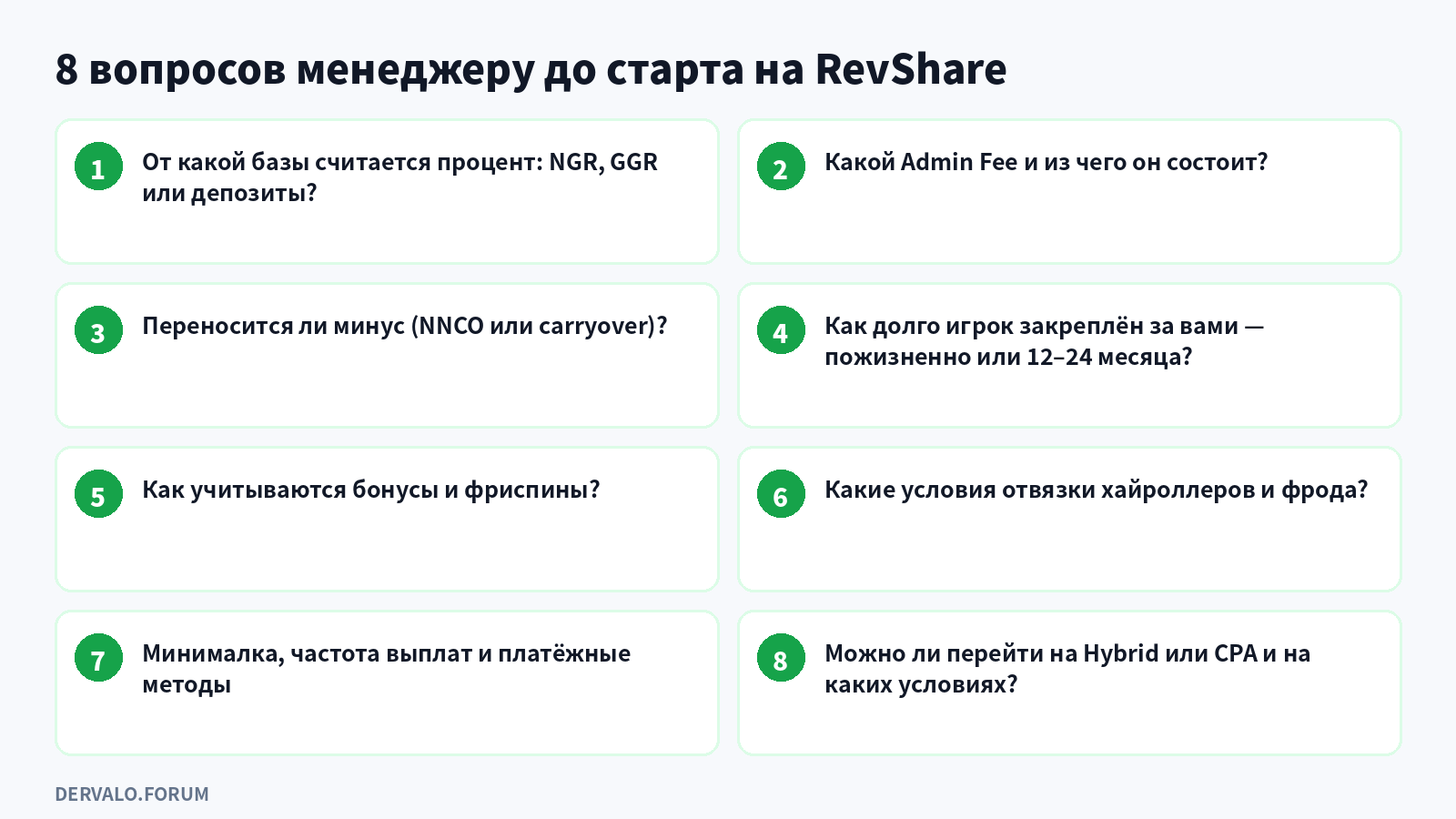
Get the answers in writing · click to enlarge
- What base is the percentage calculated from: NGR, GGR or deposits?
- What is the Admin Fee and what does it include?
- Does the negative carry over, or is NNCO in place?
- How long is a player attributed to you: lifetime or a limited period?
- How are bonuses and free spins counted?
- Under what conditions can a high roller be unlinked or revenue written off for fraud?
- Minimum payout, payout frequency and payment methods.
- Can you switch to Hybrid or CPA, and on what terms?
FAQ
What is RevShare in affiliate marketing in plain words?
A payment model in which the program pays you a percentage of the revenue your referred players or customers generate, every month while they are active. Unlike CPA, where you get a fixed amount once.
What does RevShare stand for?
Revenue Share: splitting revenue between the advertiser and the affiliate.
What RevShare percentage is normal?
In gambling and betting typical rates are 25–50 %, with some programs up to 60–70 %. Compare rates together with Admin Fee and NNCO: 40 % with no Admin Fee can beat 50 % with a high fee.
Can you go into debt with the program on RevShare?
No. A negative balance only means there are no payouts until new players' revenue covers it. You never repay it out of pocket.
How long does RevShare pay?
On lifetime revenue share, as long as the player is active. Some programs limit attribution, e.g. to 12–24 months; this is stated in the terms.
What is Hybrid?
A compromise between CPA and RevShare: a fixed payout for the first deposit to cover traffic costs, plus a reduced percentage of the player's later revenue.
Which is better for a beginner, CPA or RevShare?
If you buy traffic on social media with a limited budget, CPA or Hybrid: the money comes back fast. RevShare suits you if you have organic traffic or spare working capital and understand how long your players stay active.
Can players already referred on CPA be moved to RevShare?
Usually not: the model is fixed at the player's registration. You can switch for new traffic; it is best to confirm this with the manager in writing.
Working on revenue share? Share your experience and rates in affiliate program reviews in our catalog or discuss terms on the forum; it helps other webmasters choose a program.