



A CPA network ranking is the first thing an affiliate googles before launching, and the worst way to pick a network. Top spots in rankings are bought, reviews are written for bonuses, and the "number one in gambling" may not pay for your traffic. Here is how to choose a CPA network for your vertical and traffic source: what CPA, RevShare and Hybrid mean, where hold and shaving hide in the terms, eight criteria for comparing networks, eight signs that say "walk away", and how to test a network with a small budget before trusting it with volume.
What a CPA network is and why affiliates need one
A CPA network (affiliate network) is an intermediary between an advertiser who needs customers and an affiliate who knows how to bring them. The advertiser pays the network for results: a deposit, a sign-up, a purchase, an install. The network passes part of it to the affiliate and keeps its margin. In return the affiliate gets what a direct advertiser will not offer: dozens of offers in one dashboard, unified statistics, scheduled payouts and a manager who knows which offer converts right now.
The scheme has two sides of risk. The advertiser can reject part of the leads, the network can "shave" part of the conversions, and the payout arrives with a delay called hold. So choosing a network means choosing whom you trust with your money for two to four weeks ahead. Here is how not to get it wrong.
Payout models: CPA, RevShare, Hybrid, CPL and CPI
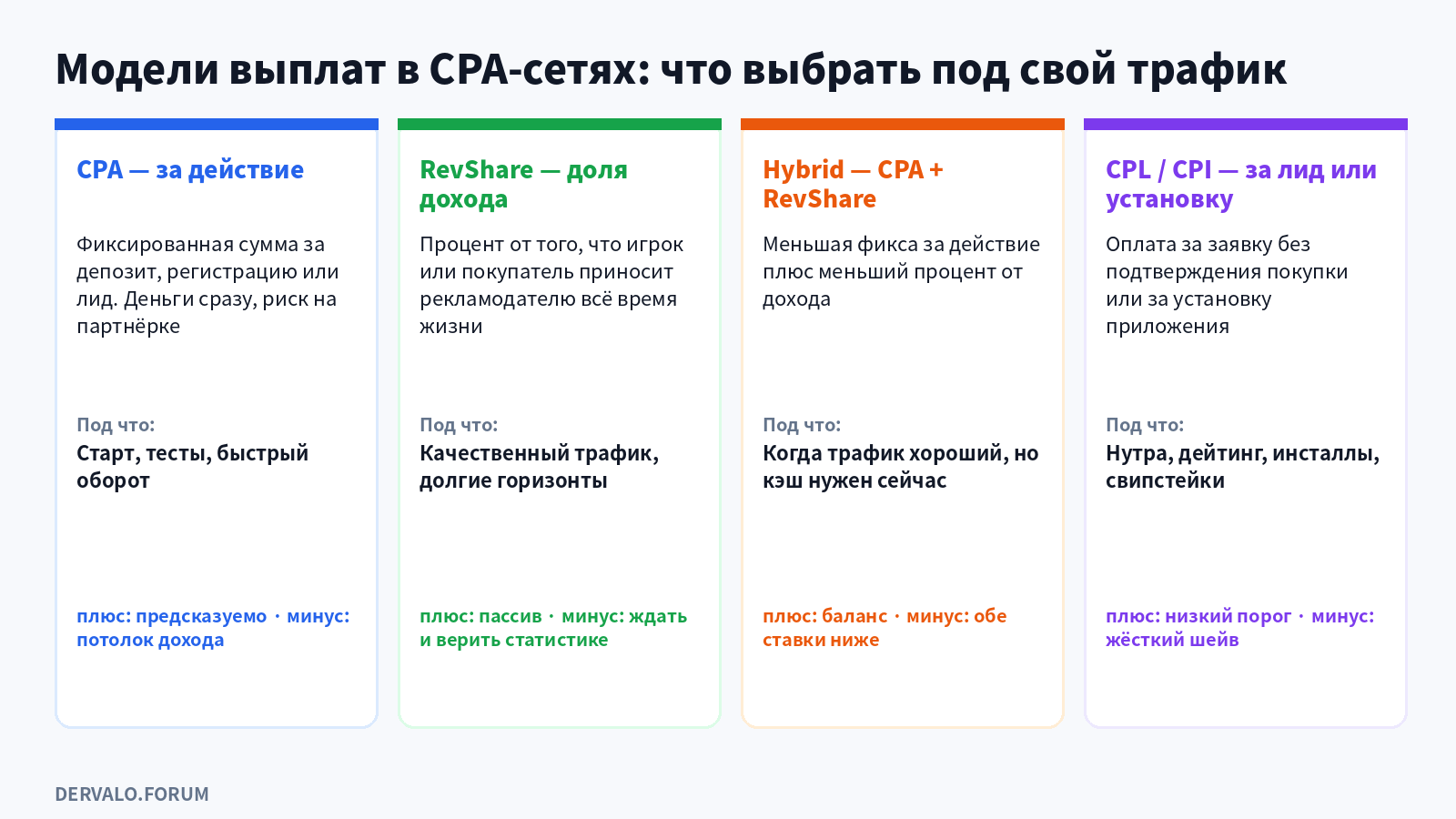
Four payout models and the traffic each fits (Russian) · click to enlarge
CPA — fixed payment per action
The network pays a fixed amount per target action: first deposit in gambling and betting, confirmed order in nutra, verified sign-up in dating. Money is predictable and arrives fast; the risk that the player does not pay off is the advertiser's. The downside is the ceiling: however much the player leaves later, you were paid once. The model for starting out, testing offers and funnels, and fast budget turnover.
RevShare — a share of revenue
Instead of a fixed fee, a percentage of what the referred player or buyer brings the advertiser over their lifetime. Good traffic on RevShare earns several times more than on CPA, but money comes over months and you have to trust the advertiser's statistics. Fits when you are sure of your traffic quality and do not depend on cash right now. One important detail: some networks run RevShare with a "negative balance", where a player's win counts against you and the minus carries over to the next month. Read the terms.
Hybrid — CPA plus RevShare
A smaller fixed fee per action plus a smaller share of revenue. A balance between "money now" and "income later", with both rates lower than in the pure models. Often available only after first volumes: the network wants to see the traffic before sharing risk with you.
CPL and CPI — per lead and per install
CPL pays per lead without a confirmed purchase (nutra, finance, dating); CPI pays per app install (installs, PWA, games). Low entry barrier, small rates, and the main risk is shaving: the network or advertiser rejects part of the leads as "low quality", and verifying that from your side is almost impossible. How PWA apps work in these funnels is covered in the PWA in affiliate marketing article.
Glossary of the terms: hold, minimum payout, shaving, KPI
- Hold — the period between a conversion and the moment money becomes available for withdrawal. The advertiser needs it to check traffic. A normal hold is stated as a number in the offer terms; a "floating" hold that gets extended after a payout request is a red flag.
- Minimum payout — the smallest amount you can withdraw. The higher it is, the longer your money sits with the network. For a first test look for a network whose minimum you can reach with one small run.
- Shaving — rejected conversions. Part of it is legitimate (duplicates, fraud, invalid numbers), part is not. The only way to gauge it: compare your tracker statistics with the network dashboard on a test.
- KPI — quality requirements: share of repeat deposits, minimum average check, retention. Miss them and the rate is cut or you are moved to RevShare. KPIs must be in the offer before launch, not appear after.
- Cap — a daily or weekly conversion limit per offer. Traffic above the cap is not paid. Check before scaling.
8 criteria for choosing a CPA network
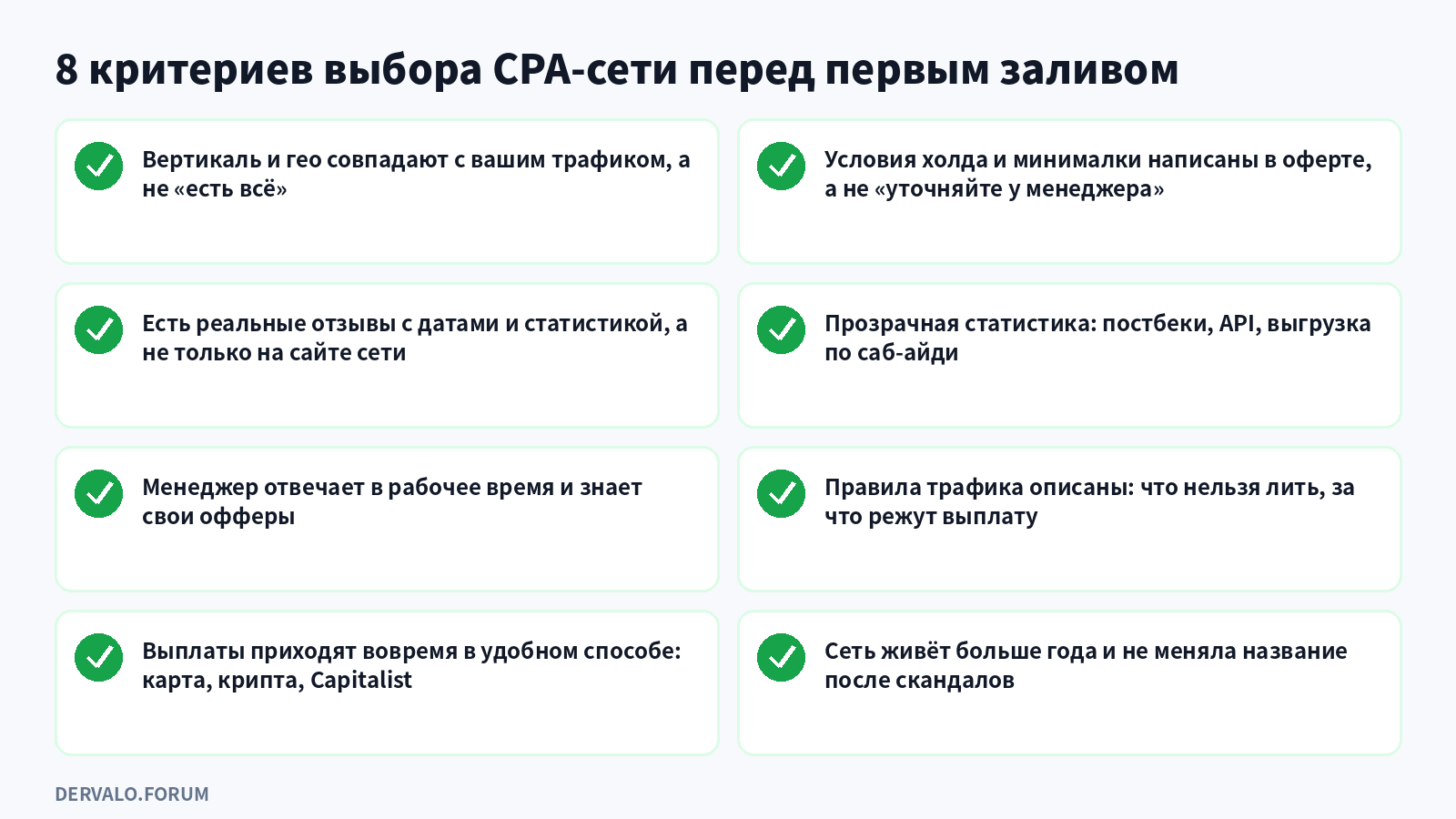
Checklist before signing up (Russian) · click to enlarge
- Vertical and geo. A network that "has everything" is usually strong in nothing. Look for one where your vertical is the core: a gambling network with direct casino advertisers, a nutra network with its own call centers, a dating network with a Smartlink. Geos must match where you actually run traffic.
- Terms in writing, not "ask your manager". Hold, minimum payout, payment schedule, KPIs and traffic rules must be written in the network rules or the offer card. If everything is "discussed individually", you will not be able to prove anything in a dispute.
- Reviews with dates and details. Not on the network's site but on forums and in catalogs where reviews come from registered users. How to read them is covered below.
- Statistics. Postbacks to your tracker, an API, breakdown by sub-IDs, update delay of hours at most. Without this you will not see shaving or be able to optimize. Which tracker to use is in the affiliate trackers overview.
- Manager. Responds during working hours, knows which offers convert from your source right now, can negotiate individual terms. Test before signing up: send a question and look at the reply.
- Traffic rules. Clearly stated which sources are banned (brand bidding, incentivized, certain geos) and what gets a payout cut. If there are no rules, they will be invented after you launch.
- Payout methods. Cards, crypto, Capitalist, payment systems that fit your team. If you cannot withdraw conveniently, nothing else matters. Payment services for teams are in the payments catalog.
- Age and reputation. Older than a year, has not rebranded after non-payment stories, present at conferences, answers negative reviews publicly. A young network with high rates is a bet on luck.
8 red flags: when to walk away from a network
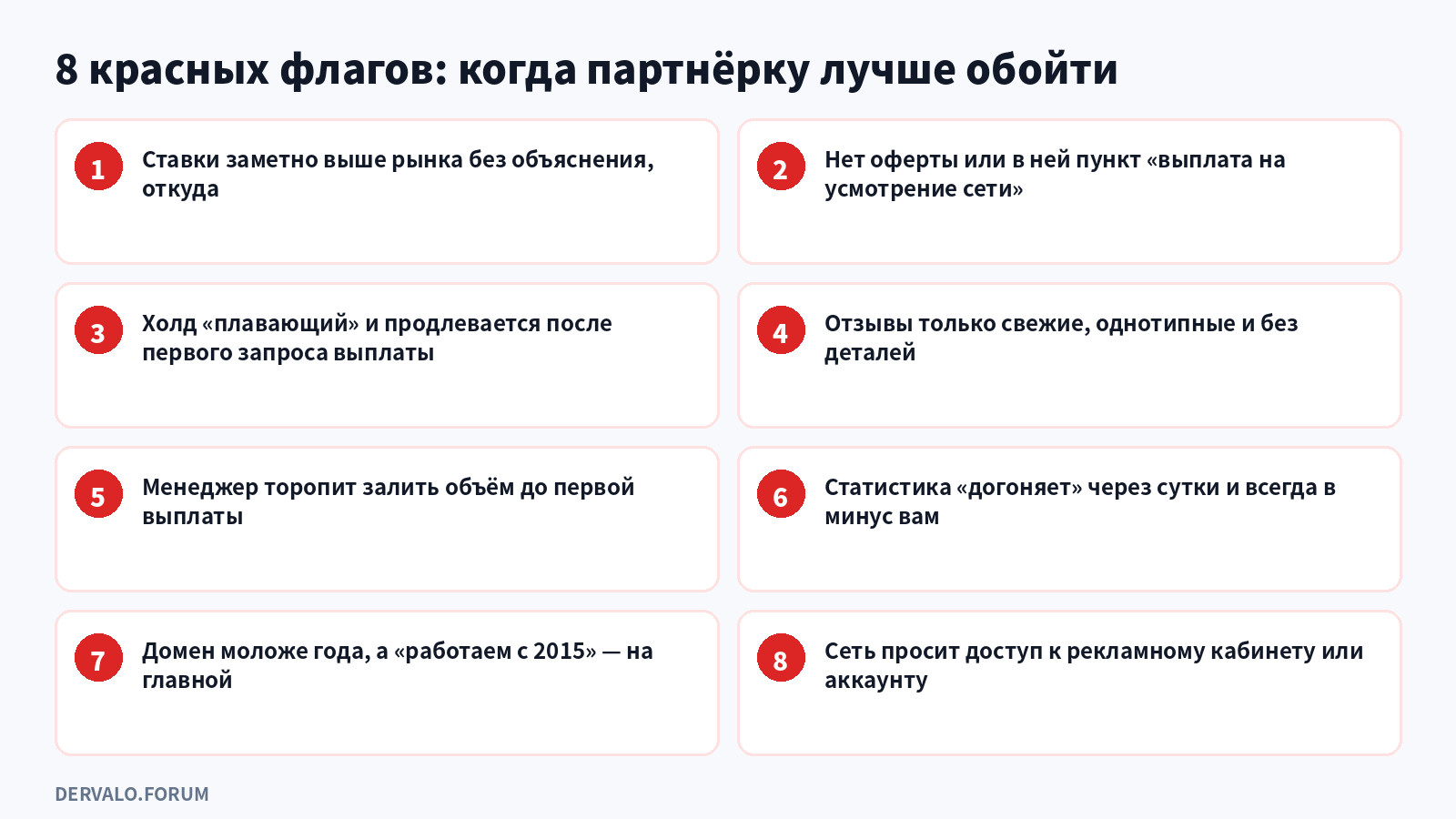
Signs that rule a network out before sign-up (Russian) · click to enlarge
- Rates noticeably above market without explanation. A direct advertiser can pay more; a reseller cannot. If the rate is higher than at networks with direct offers, ask where the margin comes from.
- No terms, or a clause like "payout at the network's discretion". Any wording that allows not paying without a reason.
- Floating hold. Extended after the first payout request "for additional checks".
- Only fresh, identical, detail-free reviews. The signature of purchased reviews. Real ones have numbers, dates, specific offers and complaints.
- The manager pushes you to send volume before the first payout. An honest network benefits from you getting paid and staying; a dishonest one from you sending as much as possible before you understand.
- Statistics "catch up" a day later and always in your disfavor. Conversions your tracker sees appear in the dashboard late and in smaller numbers.
- Domain younger than a year while the homepage says "since 2015". A one-minute whois check.
- They ask for access to your ad account. No honest network needs it. Protecting accounts is covered in the anti-detect browsers article.
How to test a CPA network before scaling: 5 steps
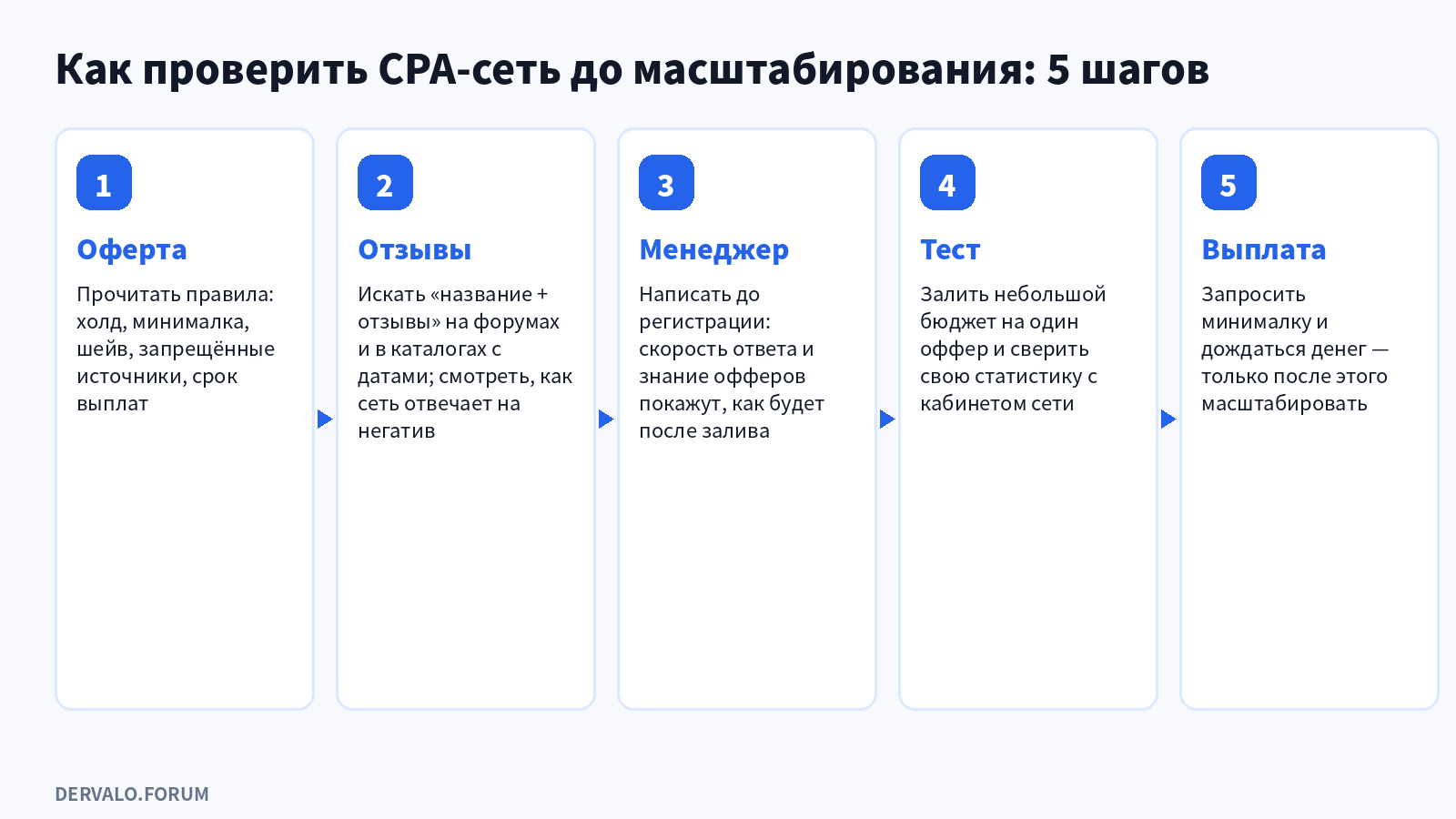
A small-budget test before trusting the network with volume (Russian) · click to enlarge
- Terms. Read the rules in full: hold, minimum payout, shaving, banned sources, payout schedule and methods, what happens in a dispute.
- Reviews. Search "network name + reviews" on forums and in catalogs where reviews are tied to accounts. Look at dates, details and whether the network answers negative feedback.
- Manager. Write before signing up: how fast they answer, whether they know the offers, whether they suggest what fits your source or say "run everything".
- Test. Run a small budget on one offer with your own tracker and postbacks. Compare conversions in the tracker and in the network dashboard; the gap is the shaving.
- First payout. Request the minimum and wait for the money. Only then scale. A network that paid a small amount on time will most likely pay a large one.
Where to find CPA network rankings and how to read reviews
Catalog rankings are useful as a list of candidates, not as a verdict. When reading a ranking, check three things: who gives the ratings (anonymous users or registered ones), whether reviews have dates and details, and how recently the card was updated. In the DERVALO affiliate program catalog only forum members can rate, and every card shows the terms: verticals, payout models, minimum payout, hold, payment methods and geos. Networks are grouped by vertical:
- gambling programs — casinos and slots, mostly CPA per first deposit and RevShare;
- betting — sports betting with seasonal peaks around tournaments;
- nutra — health products, CPA and CPL confirmed by call centers;
- dating — sign-ups and Smartlinks;
- crypto — exchanges and wallets;
- general CPA networks — several verticals in one dashboard.
How to read reviews: one negative review without a network reply is noise; a series of similar negatives with the same complaint ("did not pay after hold") is a signal; a series of similar positives within one week is a purchase. The most useful reviews have numbers: geo, source, rate, how much was paid and when.
Typical mistakes when choosing a network
- Choosing by rate. A rate 20 % higher with 30 % shaving is a loss.
- Running one offer through several networks at once without a tracker: you will not know who is shaving.
- Scaling before the first payout. The most expensive mistake on this list.
- Believing "exclusive terms" before they appear in the dashboard. A manager's promise in Telegram is not an offer term.
- Ignoring traffic rules. Running from a banned source is a legitimate reason not to pay you.
- Not keeping your own statistics. Without a tracker you will lose any dispute about shaving.
FAQ: choosing a CPA network
Which CPA network is best for gambling?
There is no "best for everyone": networks differ in geos, direct advertisers and terms for different sources. Start with the list of gambling programs in the catalog, filter by the criteria in this article and test two or three with a small budget.
CPA or RevShare: which is more profitable?
CPA for tests, unstable traffic and fast turnover. RevShare for quality traffic and a budget reserve for months of waiting. Many run tests on CPA and move proven funnels to Hybrid.
What is hold in an affiliate program?
The traffic verification period between a conversion and the money becoming withdrawable. A normal hold is stated as a number in the terms; a floating one that gets extended after a payout request is a reason to leave.
What is shaving and how do I check it?
Rejected conversions. It can only be checked with your own tracker: compare the number of postback conversions with the network dashboard on a test run.
Where can I see a CPA network ranking with reviews?
In catalogs where reviews are tied to accounts and cards show the terms. In the DERVALO catalog only forum members can rate, and programs are split by vertical.
Can I work with several CPA networks at once?
Yes, and it is normal practice: different networks are strong in different geos and verticals. The mandatory condition is a tracker with postbacks from each network, otherwise you cannot compare quality.
How do I know a network will not pay?
By the red flags in this article: no terms, floating hold, manager pressure to send volume before the first payout, statistics always against you, purchased reviews. The most reliable check is requesting the minimum payout after a small test.
Worked with networks from the catalog? Leave a review on the program card: it helps others and keeps the ranking honest. Questions about specific networks and offers go to the Affiliate Programs section of the forum.