




Google has updated its guidance on generative AI content: anything written with AI should now be manually checked for accuracy before publishing. The new wording appeared in Google Search Central documentation on October 1: "it is critical to manually factcheck and review all AI-generated content." And it's not just body text — title tags, meta descriptions, structured data and image alt text need checking too. Here is what changed, whether Google penalizes AI content and how to publish content written with ChatGPT or Gemini.
What changed in Google's guidance
- Where: the "Google Search's guidance on using generative AI content on your website" page in Search Central. Updated October 1; the previous revision was in October of last year.
- The key point: Google says AI outputs may contain inaccuracies — "hallucinations" — because models predict a likely sequence of words based on their training data. So all AI content should be manually checked for accuracy and trustworthiness before it goes live.
- The word "critical". As Search Engine Roundtable noted, Google rarely uses that wording in its documentation — it's a strong signal.
- Metadata too. Check what shows up in search results as well: the title tag, meta description, structured data and image alt text.
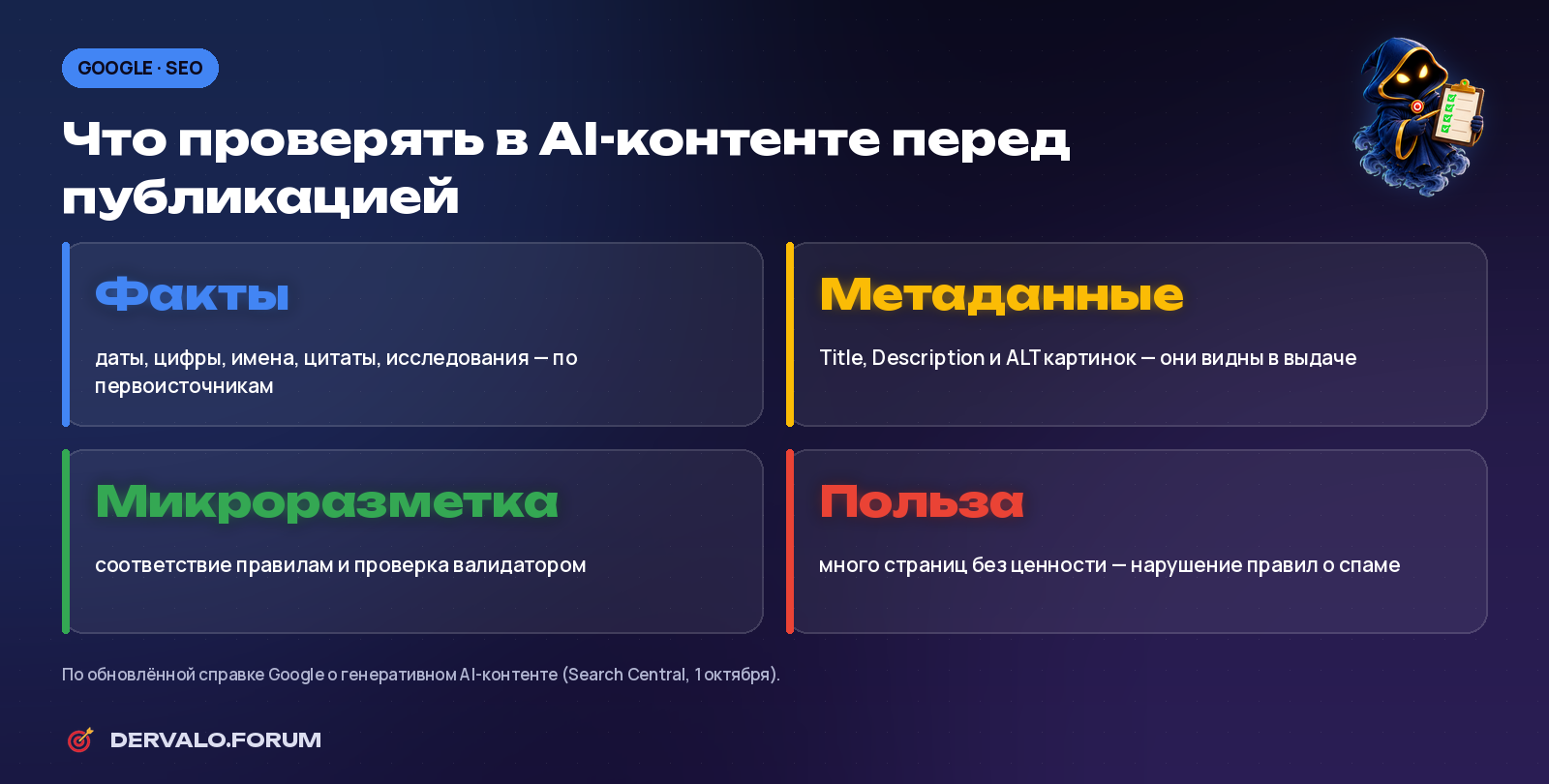
Checklist: what Google says to check in AI content (chart labels in Russian)
Does Google penalize AI content?
No. You can still use AI — for research, outlines, drafts and working with data. Google has not introduced a penalty for text from ChatGPT or Gemini, nor launched a new algorithm that "detects" AI. This is a guidance update, not a new ranking rule.
Two limits still apply:
- Mass generation without value is spam. Using AI to publish many pages that give readers nothing new may violate Google's scaled content abuse policy.
- The site is responsible for the facts. It doesn't matter who wrote the draft — a person or a model. If the text contains an error, the publisher owns it.
The update came shortly after Google's September spam update. Google hasn't said the two are linked, but they point the same way — less low-value content at scale. More in our news on the Google spam update.
Where AI gets things wrong most often
AI mistakes are usually invisible on a quick read: the text is smooth and well structured, but inside there's a wrong number or a conclusion the source never made. The usual suspects:
- dates and numbers — a wrong launch year, an extra zero, a percentage from a different study;
- names, job titles and company names;
- quotes — AI may paraphrase a quote and present it as direct speech;
- the status of an event — the source says a feature is being tested, the text says it has "launched";
- the scope of conclusions — a single-country study becomes "the whole European market";
- non-existent product features and links that lead nowhere.
How to publish AI content without losing rankings
- Collect sources. Go to the primary source — an official blog, help page or study — not someone else's summary.
- Draft with AI. Outline, first draft, translation — this is where AI saves the most time.
- Check every fact. Numbers, dates, names and quotes against the source. Check meaning, not just numbers: "testing" and "launched" are different stories.
- Add your own value. A rewrite of five articles is just a sixth rewrite. Experience, a case study, a calculation, a comparison, practical takeaways for your audience — things others don't have.
- Check the metadata. Title, description, image alt text and structured data — AI wrote those too, and mistakes there show up right in search results. Run your markup through a validator.
- Edit and publish. Style and SEO come last, once the facts are right.
What it means for affiliates and media buyers
Many affiliates run SEO sites, offer reviews, doorways and pre-landers built on AI text. The takeaway is simple:
- Unchecked AI sites built for SEO traffic are at risk, especially when there are many similar pages.
- Reviews of affiliate programs and services with made-up numbers hurt trust — with both Google and readers. Check offer terms on the program's site or with the manager, as we did in our affiliate program ranking.
- For "money" sites (finance, gambling, health) Google's accuracy bar is always higher, and mistakes cost more.
SEO and Google news in our Telegram channel.
FAQ
Can you use AI for SEO content?
Yes. Google doesn't ban AI content. What matters is that the text is useful and the facts are manually checked before publishing.
Does Google penalize ChatGPT content?
Not for using ChatGPT as such. Sites run into trouble when they mass-publish AI pages with no value to readers — that violates the spam policies.
What does Google say to check in AI content?
Factual accuracy and trustworthiness, plus metadata: title tags, meta descriptions, structured data and image alt text.
Do you have to disclose that content was written with AI?
It isn't mandatory, but Google suggests telling users how content was created where it makes sense. For ecommerce: AI-generated images should carry IPTC metadata, and AI-generated product attributes should be labeled separately.
Is this a new Google algorithm?
No, it's a documentation update — quality guidance, not a new filter.
Sources: Google Search Central (guidance on generative AI content, documentation update log), Search Engine Roundtable, Search Engine Journal.