

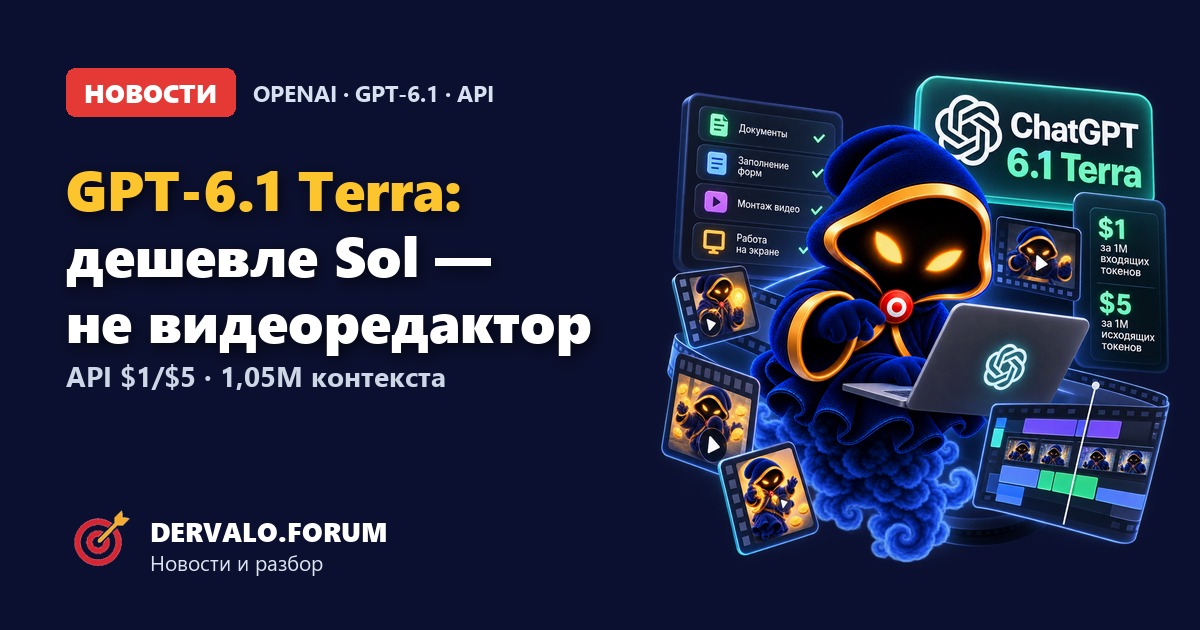
On October 26, 2026, OpenAI released GPT-6.1 Terra, a more affordable model in the GPT-6.1 family. The headline numbers: $1 per million input tokens and $5 per million output tokens, a 1.05M-token context and computer use. But the "mass video editing" headlines need a correction: natively, Terra accepts text and images and returns text. It does not generate or edit video.
- Price: $1/$5 per 1M tokens, half the price of GPT-6.1 Sol.
- Context: 1,050,000 tokens, up to 128,000 output tokens.
- Input/output: text and images in, text only out.
- Tools: computer use, code interpreter, hosted shell, web/file search, MCP, image generation.
What the model is
GPT-6.1 Terra is the model ID gpt-6.1-terra, replacing GPT-5.6 Terra. OpenAI positions it as a cheaper alternative to GPT-6.1 Sol: standard pricing is $1/$5 versus $2/$10 for Sol and $10/$50 for GPT-6 Astra. Its knowledge cutoff is June 1, 2026.
Officially, Terra accepts text and images and returns text. Audio, video, video generation and image editing are not supported as native modalities. That matters for an honest assessment: the model can help with editing through code, ffmpeg, third-party services or tools, but it is not a video editor out of the box.
| Parameter | GPT-6.1 Terra |
|---|---|
| Model ID | gpt-6.1-terra |
| Input | Text, images |
| Output | Text |
| Context | 1,050,000 tokens |
| Max input | 922,000 tokens |
| Max output | 128,000 tokens |
| Knowledge cutoff | June 1, 2026 |
| Fine-tuning | Not supported |
| Responses API | Supported; tool calling requires the Responses API |
What it costs
Standard pricing is $1 per 1M input tokens and $5 per 1M output tokens. Cached input is $0.05 per 1M, cache writes are $1.25 per 1M for 30-minute retention ($2.50 for 12 hours). Batch and Flex are 50% cheaper; Fast mode is 2× the standard price.
There is a long-context catch: prompts above 272,000 input tokens are billed at 2× input and cache rates and 1.5× output for the whole request. Loading an entire archive into Terra may be cheaper than Sol, but it is not free. For recurring work, calculate the cost of one successful task, not just the token price.
Example: if a task consumes 100,000 input and 10,000 output tokens, a standard call costs about $0.15. The same tokens would cost about $0.30 on Sol and about $1.50 on Astra. This is a price-sheet estimate, not a forecast of your bill: actual usage depends on the prompt, cache and output length.
What it can actually do
OpenAI lists practical use cases: matching product photos to catalog entries, interpreting technical drawings, acting on application screens and drafting text. Terra has tools for that:
- Computer use — the model can act in interfaces: click, fill forms, move through screens. This is not magic: it needs access, stable UI and human review.
- Code interpreter and hosted shell — calculations, file processing, scripts, including supporting workflows for images and video.
- Web search and file search — research and document work.
- Image generation — as a separate tool, not as a native output modality.
- MCP and tool search — connecting external tools and agent workflows.
So "Terra can edit video" is imprecise. It can help write an ffmpeg script, break down a storyboard, select frames or call an external service. But there is no native video editor, timeline or renderer inside the model. If you build agent workflows for ad accounts, see the Meta Ads MCP and CLI breakdown.
Benchmarks: where it is strong, where it is not
OpenAI publishes its own measurements. They are useful but not independent: the numbers are self-reported and the tasks may differ from yours. Key results:
| Test | Terra | Sol | GPT-6 Astra |
|---|---|---|---|
| Agents' Last Exam (max) | 60.0% / $1.01 per task | 58.6% / $2.00 | 59.3% / $7.24 |
| MMMU-Pro Vision (max) | 85.5% | 86.3% | 86.7% |
| OSWorld 2.1 (max) | 74.2% | 78.0% | 80.9% |
| Terminal-Bench 4.0 (max) | 50.3% | 55.9% | 58.2% |
The takeaway: Terra is close to Sol and Astra on agentic and visual tasks, but weaker at complex coding. OpenAI itself recommends Sol or Astra for the hardest engineering tasks. OpenAI also claims Terra completes tasks more than three times faster than Sol and Astra; that is a vendor claim, not an independent measurement.
What it means for affiliate marketing
For a media buyer, Terra is interesting not for "general intelligence" but for the cost of repetitive work:
- Offer and document analysis. Affiliate terms, platform rules, briefs, tables — Terra reads text and images, but facts still need checking.
- Screen work. Filling forms, repetitive actions in dashboards, collecting data. Potentially useful, but the risk of error is high: do not give the model access to payments or critical settings without a human.
- E-commerce. Matching product photos to a catalog, parsing listings, preparing descriptions — one of the official use cases.
- Creative and content. Drafts, translations, landing page structure, image prompts. Video only through external tools and code, not natively. For a content pipeline, see the AI creative factory guide.
- Agents. MCP, tool search and computer use enable chains, but economics should be measured by cost per successful task, not tokens.
For recurring tasks, use Batch/Flex, cache repeated prompts and avoid sending unnecessary gigabytes of context. For urgent work, use standard mode; Fast mode costs 2× and is not always needed.
How to test it on your tasks
- Pick three real tasks: parsing offer terms, filling a test form on screen, preparing a product description from a photo.
- Compare Terra, Sol and Astra by success rate, time and cost per successful task.
- Count edits: how many minutes a human spends fixing the answer. A cheap model with many corrections can be more expensive.
- Test the tools: computer use, file search, code interpreter and MCP on your interfaces and files.
- Measure cache and batch: repeated prompts and non-urgent jobs can change the economics significantly.
Limitations and risks
- No native video/audio. Do not plan mass video editing "with Terra" without an external pipeline.
- Vendor benchmarks. Test on your own tasks; the numbers do not guarantee results in your vertical.
- Computer use needs supervision. UI errors, access, payments and personal data are risk areas.
- No fine-tuning. Customization goes through prompts, tools and external pipelines.
- Long context costs more. Above 272K input tokens, input is billed at 2×.
- Availability. API and ChatGPT Work/Codex availability may differ by plan and region; check your account.
Bottom line
GPT-6.1 Terra is not a "$1 video editor"; it is a cheaper model for visual analysis, computer use and agentic tasks. It can lower the cost of high-volume operations and looks competitive in agent benchmarks, but it is weaker at complex coding and does not replace video production. Test it on your tasks and calculate the cost of a successful result, not just the price per million tokens.
FAQ
Can GPT-6.1 Terra edit video?
Not natively. The model accepts text and images and returns text; it does not generate video. It can help with code, storyboards or an external pipeline, but it is not a built-in video editor.
How much does GPT-6.1 Terra cost?
$1 per 1M input and $5 per 1M output tokens. Cached input is $0.05, Batch/Flex is 50% cheaper, Fast mode is 2×. Prompts above 272K input tokens cost more.
How is Terra different from Sol?
Terra is cheaper: $1/$5 versus $2/$10. It is close on visual and agent tests but weaker at complex coding; Sol is better for the hardest tasks.
Can I use Terra for affiliate marketing?
Yes, for document and image analysis, descriptions, forms and agent workflows. But verify facts and do not give the model critical access without supervision.
Does it support fine-tuning?
No. Customization goes through prompts, tools, MCP and external pipelines.
Which tools are supported?
Computer use, code interpreter, hosted shell, web search, file search, image generation, MCP, tool search and other Responses API tools.
Is it the best model for coding?
No. On Terminal-Bench Terra trails Sol and Astra; OpenAI recommends the larger models for complex engineering.
Where is Terra available?
In the API as gpt-6.1-terra; also in ChatGPT Work and Codex on some plans. Availability depends on account and region — check the interface.
Sources
Official data: OpenAI API — GPT-6.1 Terra, OpenAI — Introducing GPT-6.1 Terra. Benchmark and availability analysis: MarkTechPost. DERVALO.FORUM internal materials: AI tools for affiliate marketing, AI creative factory.