

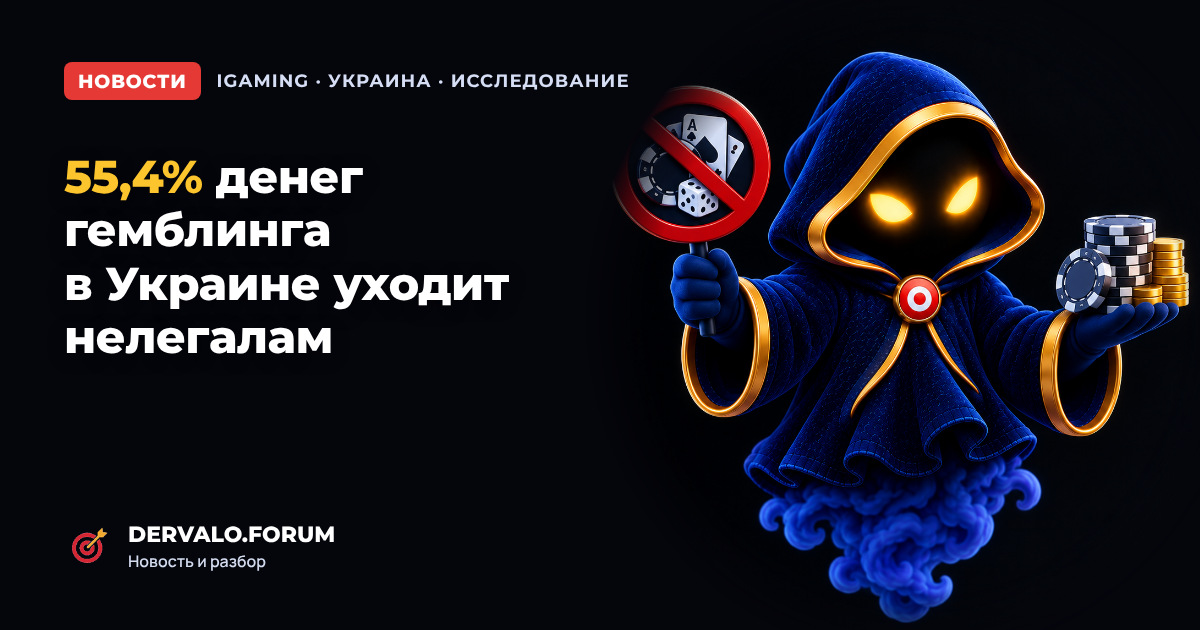
More than half of the money Ukrainians spend on gambling goes to unlicensed operators. That's the finding of a new Kantar Ukraine study published on October 15: the illegal segment accounts for 55.4% of player spending, the legal one for 44.6%.
Who was surveyed and how
- Commissioned by the Association of Ukrainian Gambling Business Operators, which represents licensed operators. Keep that in mind when reading the conclusions.
- Sample: an online survey of 800 Ukrainians aged 18–69 who gambled in the past three months. It's a study of players, not the whole population.
- Timing: fieldwork ran August 12–26.
Key numbers
- 85.6% of players used illegal casinos or bookmakers. Of these, 68.4% play with both legal and illegal operators, and 17.2% only with illegal ones.
- Only 14.4% play exclusively with licensed operators.
- The average player spends UAH 1,956 a week and about 5 hours. The share spending more than UAH 2,000 a week rose from 14% to 21%.
- The association estimates the illegal market at about UAH 60 billion a year, with up to UAH 20 billion in lost taxes. These are industry estimates, not tax authority data.
Why players go to illegal operators
- faster payouts — 46%;
- a more convenient site or app — 45%;
- better bonuses — 33%;
- a wider game selection — 25%;
- winnings paid without tax withheld — 22%;
- crypto payouts — 9%;
- playing without age verification — 8%.
This is the players' own opinion, not proof that illegal operators actually pay faster. But it shows that the product and payouts decide, not advertising.
Payments and legality through players' eyes
Legal operators run 82% of transactions through bank cards and don't work with crypto or e-wallets. The illegal segment relies on crypto, wallets and terminals. The share of players withdrawing winnings in crypto rose from 6% to 10%.
A state license matters to 63% of respondents. But about a quarter wrongly see an ISO certificate as a sign of legality. And 42% had trouble with verification, which also pushes people toward sites without checks.
Channels and trends
The main channels are websites and mobile apps. Apps are more popular with slots and poker players; messengers are used mostly for lotteries and poker. Sports betting is gaining ground: there are more bettors, and they bet more often. In slots and online casinos, the share of people playing less than once a month is growing.
The market isn't growing, but it isn't shrinking either
This isn't the first wave of the study. In spring 2026, with a sample of 2,500, Kantar put the illegal share at 56.7%, and before that at 52.1%. The new 55.4% is about the same level. Samples and methods differ, so compare the figures with care. But the overall takeaway is clear: blocking isn't changing the picture yet. According to the association, closing one site takes at least 10 days, while clones appear within 1–2 days.
What others got wrong
- Some retellings say the study "doesn't show whether the market grew." In fact, Kantar has earlier waves: 52.1% and 56.7%. The current 55.4% points to a consistently high level rather than growth.
- Many don't mention that the sample covers only active players. According to Ukraine's Ministry of Digital Transformation (June 2026), 5% of adult Ukrainians gambled in the past year.
What it means for affiliate marketers
- Ukraine means licensed only. Sending traffic to operators without a Ukrainian license risks blocks, unpaid commissions and legal trouble. If you work with the UA GEO, check the brand's license in the regulator's register.
- The product decides. Players choose by payout speed and convenience, not ads. Offers with fast payouts retain traffic better, and that shows up in retention and RevShare.
- Sports betting is growing. Betting is becoming more regular while casino play is becoming less frequent. Keep that in mind when picking a vertical for Ukraine. More on gambling metrics in our gambling vertical guide.