

AI does not make a creative from one prompt; it makes building blocks that a creative is assembled from by hand. Whoever expects a ready ad from Sora gets artifacts and the uncanny valley; whoever builds a five-step pipeline gets dozens of unique variants a day for any geo. Here is that pipeline for gambling, step by step: how to set a hypothesis, what prompts to give Midjourney and Ideogram for stills, how to animate a frame in Kling and Runway, how to voice it with ElevenLabs, how to edit and produce five test versions. The prompts are ready to copy; change the geo. Tool prices are from official sites as of September 2026.
Why AI creatives are a pipeline, not a button
Video models in 2026 produce convincing 5–10 seconds, not a 30-second ad with a story: on long generations faces, hands, text and scene logic drift. So the working scheme is not "generate a video" but "generate frames and short motions, assemble in the editor". That gives three advantages over stock and borrowed creatives: uniqueness (every variant is new, no hash duplicates), speed (dozens of test versions instead of two or three) and geo adaptation (face, interior and language for a specific country in minutes). Where to source material without AI and how to test is in the base article on creatives for affiliate marketing.
The pipeline: 5 steps from idea to test
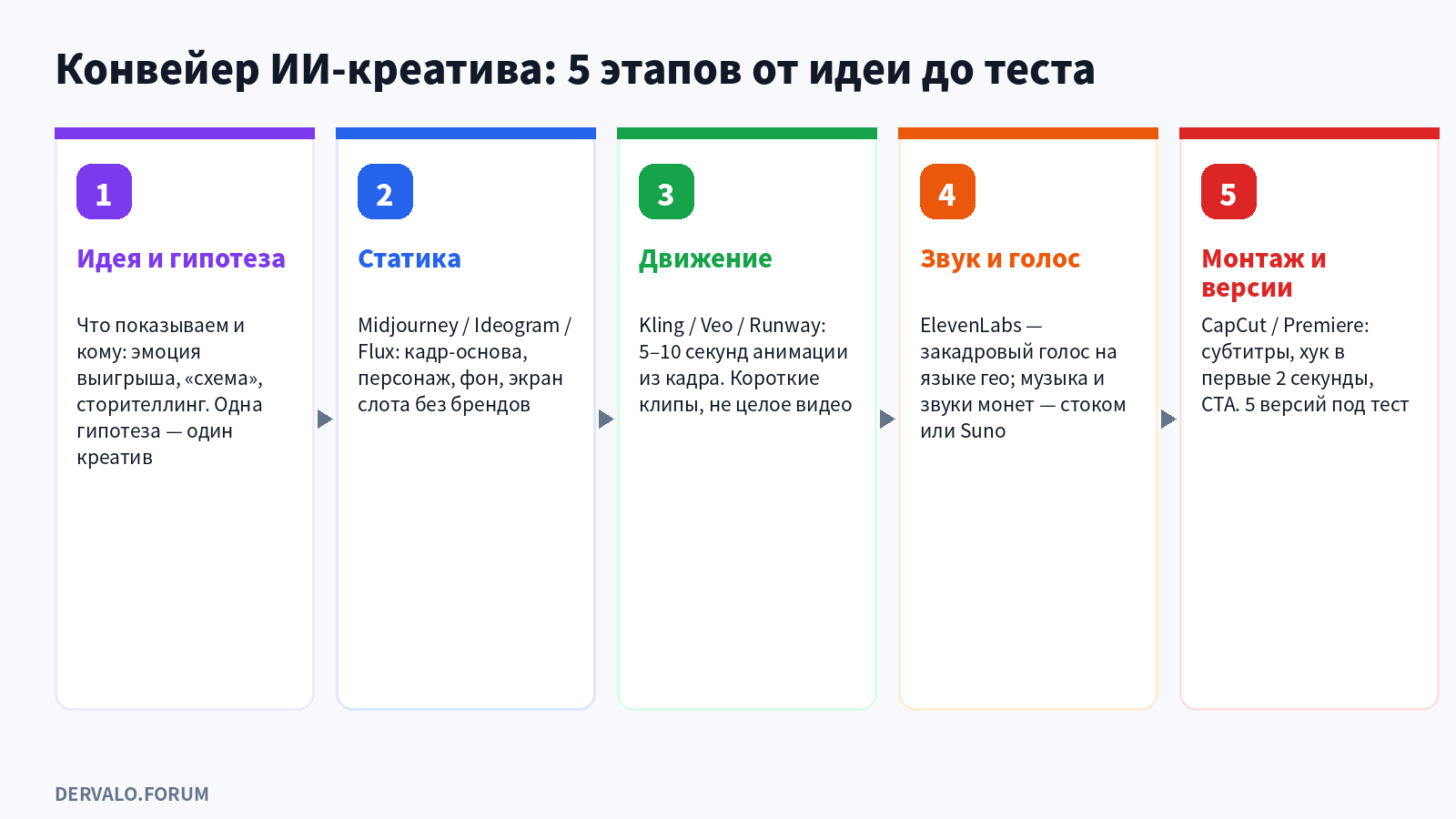
Each step has its tool; the output is 5 test versions (Russian) · click to enlarge
Step 1. Hypothesis: what we show and to whom
One creative, one hypothesis. Not "make a nice casino video" but specifically: "Latin American man 25–35, emotion of an unexpected win on his phone at night in the kitchen, hook is a close-up of the face in the first second". Four working formats for gambling:
- Win emotion. Face, reaction, phone with bright symbols. The most common and most competitive.
- "The scheme". A person shows "how I play": screen, gestures, voice-over. Leads to the bridge page for "details".
- Storytelling. "Yesterday from $10, today…": a series of two or three scenes.
- Native UGC. Shot "on a phone", grain, natural light: passes moderation and does not look like an ad.
Write the hypothesis down before generating; it becomes the prompt's basis and the criterion for judging the test.
Step 2. Stills: Midjourney, Ideogram, Flux
The base frame: character, scene, light. Motion is made from it later. The prompt structure that works for creatives:
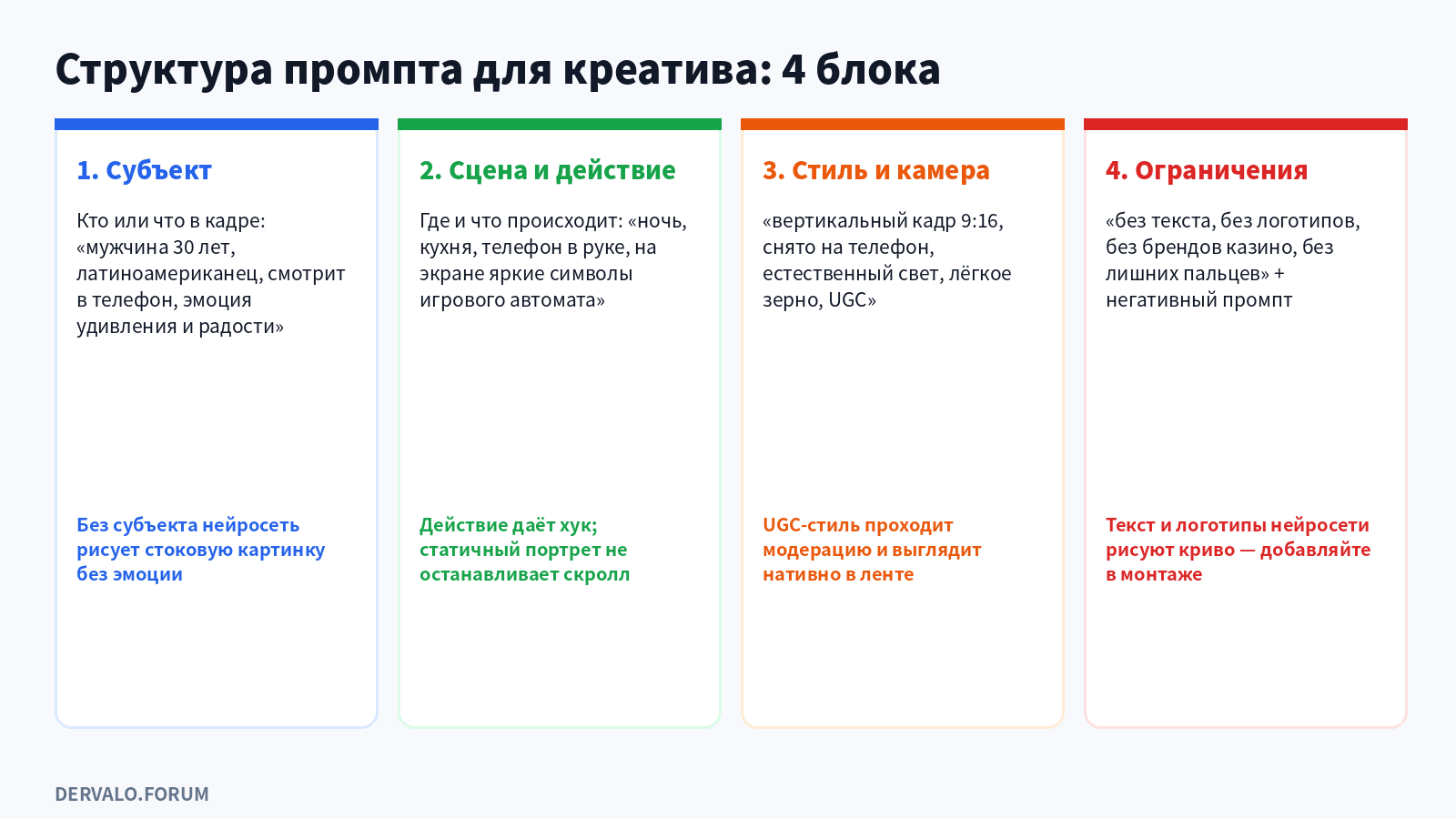
Subject → scene → style → constraints: four blocks in every prompt (Russian) · click to enlarge
"Win emotion" prompt, Midjourney (geo: Latin America):
Vertical 9:16 candid photo, young Latin American man, late 20s, sitting at a kitchen table at night, holding a smartphone close to his face, expression of sudden surprise and joy, mouth slightly open, eyes wide, warm lamp light, phone screen glowing with colorful abstract shapes, shot on phone, slight grain, UGC style, natural skin texture --ar 9:16 --style raw --no text, logo, watermark, extra fingers
"Scheme" prompt, Ideogram (geo: India):
Vertical smartphone photo, Indian man in his 30s in a casual t-shirt, sitting on a sofa in a modest living room, pointing at his phone screen with one finger, confident half-smile, phone shows bright abstract game-like interface without any text, daylight from a window, realistic, no logos, no brand names, no text
What matters: geo is set through appearance, interior and light; text and logos are banned in the prompt and added in editing; "shot on phone / UGC / grain" gives nativeness. Generate 8–12 frames, pick 3–4 with the strongest emotion. Ideogram holds composition better and can do text, Midjourney gives more "alive" faces, Flux is the fast and cheap option for mass versions.
Step 3. Motion: Kling, Veo, Runway
From the chosen frame, 5–10 seconds of motion via image-to-video. Do not ask the model to "shoot a video"; ask for one specific action:
Image-to-video prompt, Kling / Runway:
The man slowly raises his eyes from the phone to the camera, his surprise turns into a wide smile, he leans back slightly, subtle handheld camera shake, warm lamp light flickers on the phone screen, realistic motion, 5 seconds
Prompt for the "slot screen" frame (no brands):
Close-up of a smartphone screen showing an abstract colorful reel animation, bright symbols spinning and stopping one by one, golden particles burst from the screen, camera slowly pushes in, no text, no logos, 5 seconds
Rules: one frame, one motion; a face close-up turning to camera is the hook; keep hands and phone static so fingers do not drift. Three or four such clips make a 15-second ad. Runway is the simplest entry with a free plan, Kling has the best motion physics, Veo has realistic light but costs more.
Step 4. Sound and voice: ElevenLabs
A voice-over in the geo's language is what turns a set of clips into a creative. ElevenLabs: pick a voice for the geo (male Latin American Spanish, Hindi, Brazilian Portuguese), paste the text, get the track. Write the text without stop words: not "casino" and "bet" but "app", "game", "it hit". A 15-second script, three lines:
"I thought it was just another game. Played from my phone in the kitchen, and here is what happened a minute later. Link in the description, try it yourself."
Music and coin sounds come from stock libraries or Suno for a unique track. Do not use recognizable melodies of real slots; that is a brand.
Step 5. Editing and test versions
CapCut or Premiere: clips in order, subtitles (no stop words, large, in the safe zone), a hook in the first two seconds, a CTA at the end. From one set of assets, five versions that differ by one variable:
- Hook: face close-up vs phone screen close-up.
- Scene order: reaction → screen vs screen → reaction.
- Voice: male vs female.
- CTA: "link in description" vs "try it yourself".
- Length: 9 seconds vs 15 seconds.
After the test you know what worked. For a TikTok UBT farm, unique versions per account are made from the same assets: crop, mirror, speed, different sound; details in the TikTok UBT traffic article.
What the pipeline costs
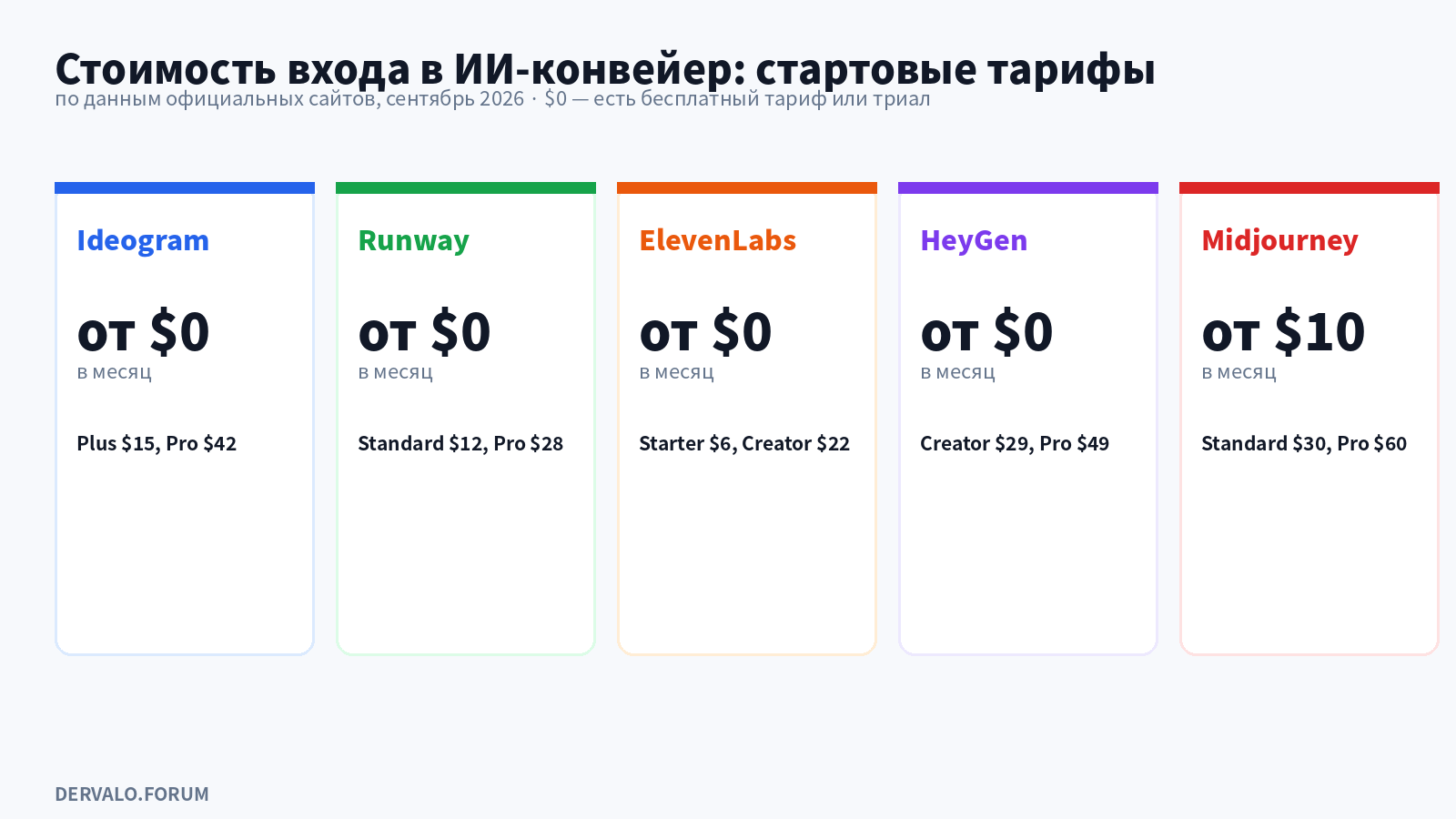
Starting plans from official sites · click to enlarge
| Tool | Task | Free | Paid plans |
|---|---|---|---|
| Midjourney | stills, faces | no | Basic $10, Standard $30, Pro $60, Mega $120 |
| Ideogram | stills, composition, text | yes | Plus $15, Pro $42, Team $20/user |
| Runway | image-to-video | yes | Standard $12, Pro $28, Max $76 |
| Kling | image-to-video, motion physics | credits | plans on site |
| ElevenLabs | voice in the geo's language | 10,000 credits/mo | Starter $6, Creator $22, Pro $99 |
| HeyGen | talking avatar (UGC) | yes | Creator $29, Pro $49, Business $149 |
| CapCut | editing, subtitles | yes | Pro on site |
The minimum working set is Ideogram or Midjourney for stills, Runway for motion, ElevenLabs for voice, CapCut for editing: the start fits into one or two paid plans, the rest on free tiers. Tool cards with reviews are in the services catalog.
Moderation: how AI creatives pass Facebook and TikTok
Platforms do not ban for "made by AI"; they ban for what is in the frame. Three rules:
- No brands or interfaces of real casinos. Abstract symbols and a "game-like interface" in the prompt instead of a slot copy. That is both copyright and the main moderation trigger.
- No stop words in subtitles, voice-over or on screen. Moderation recognizes speech and text in video. Euphemisms, emoji, colloquial phrasing.
- Realism without the uncanny valley. Overly smooth faces and six fingers are not only low CTR but a reason for user reports, after which the ad goes to manual review.
Meta and TikTok label AI-generated content when their detectors recognize it; the label itself is not a ban, but UGC style with grain and natural light lowers the chance of detection. What to do if the account still goes down is in the ad account ban article; how not to link accounts is in the anti-detect browser comparison. If you send to a pre-lander that will not pass moderation, a cloaker solves it at the link level, not the creative.
8 AI creative mistakes
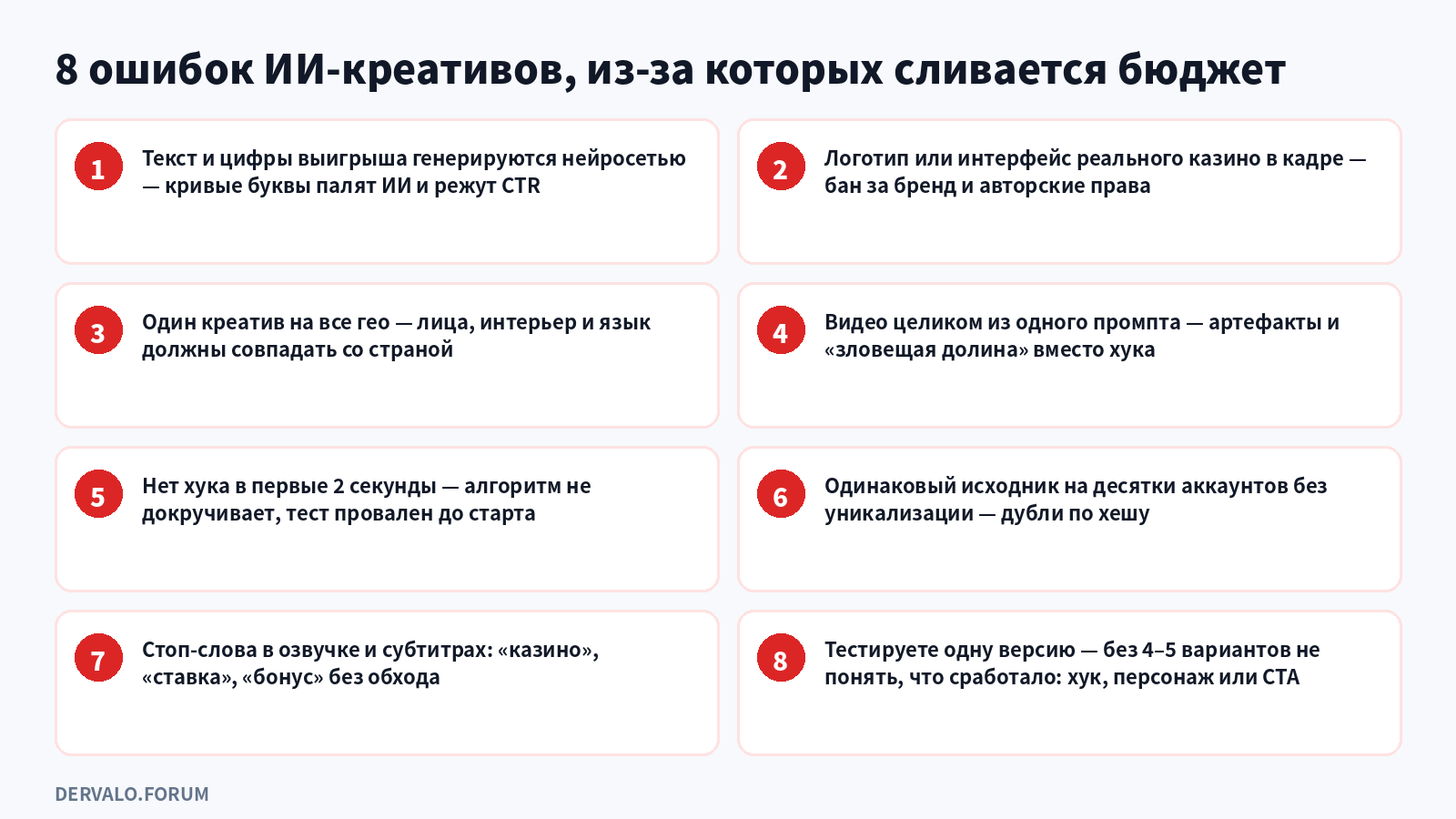
Checklist before the test (Russian) · click to enlarge
- Text and win numbers generated by AI. Crooked letters expose AI and cut CTR; all text is added in editing.
- A real casino's logo or interface in frame. Ban for brand and copyright.
- One creative for all geos. Face, interior and language must match the country.
- A whole video from one prompt. Artifacts instead of a hook; the right way is short clips plus editing.
- No hook in the first two seconds. The algorithm does not push it; the test fails before it starts.
- One source on dozens of accounts without uniquification. Hash duplicates.
- Stop words in voice-over and subtitles. Moderation hears and reads.
- Testing one version. Without 4–5 variants you cannot tell what worked.
FAQ: AI creatives for affiliate marketing
Which AI is best for gambling creatives?
Not one but a chain: Midjourney or Ideogram for stills, Kling or Runway for motion, ElevenLabs for voice, CapCut for editing. No single tool makes a finished creative from one prompt.
Can a video creative be made entirely with AI?
A 5–10 second clip, yes. A 15–30 second ad with a story, only by assembling several clips in the editor: faces and scene logic drift on long generations.
Does Facebook ban AI creatives?
Not for the fact of generation. It bans for brands in frame, stop words in text and audio, and reports about unnatural faces. UGC style and edited-in text instead of generated text remove most of the risk.
How do I write a prompt for a creative?
Four blocks: subject (who, age, appearance for the geo, emotion), scene and action, style and camera (9:16, "shot on phone", UGC), constraints (no text, logos, brands) plus a negative prompt. Examples are above.
How much does making creatives with AI cost?
Start on the free tiers of Ideogram, Runway, ElevenLabs and CapCut. A working set is one or two paid plans: Midjourney from $10, Runway from $12, ElevenLabs from $6 a month. Prices from official sites as of September 2026.
How do I adapt a creative to another geo?
Change appearance, interior and light in the prompt for the country, regenerate stills, re-voice in the geo's language in ElevenLabs. The editing scheme stays the same; it is minutes, not hours.
Do I need a talking avatar (HeyGen) for gambling?
For the "scheme" format and UGC reviews, yes: the avatar speaks the text in the geo's language on camera. For win emotion, no; a live reaction from image-to-video is stronger there.
Making creatives with AI? Share which prompts and chains work in your geo in the Creatives section of the forum. The tools from this article are in the services catalog, where you can also leave a review.