


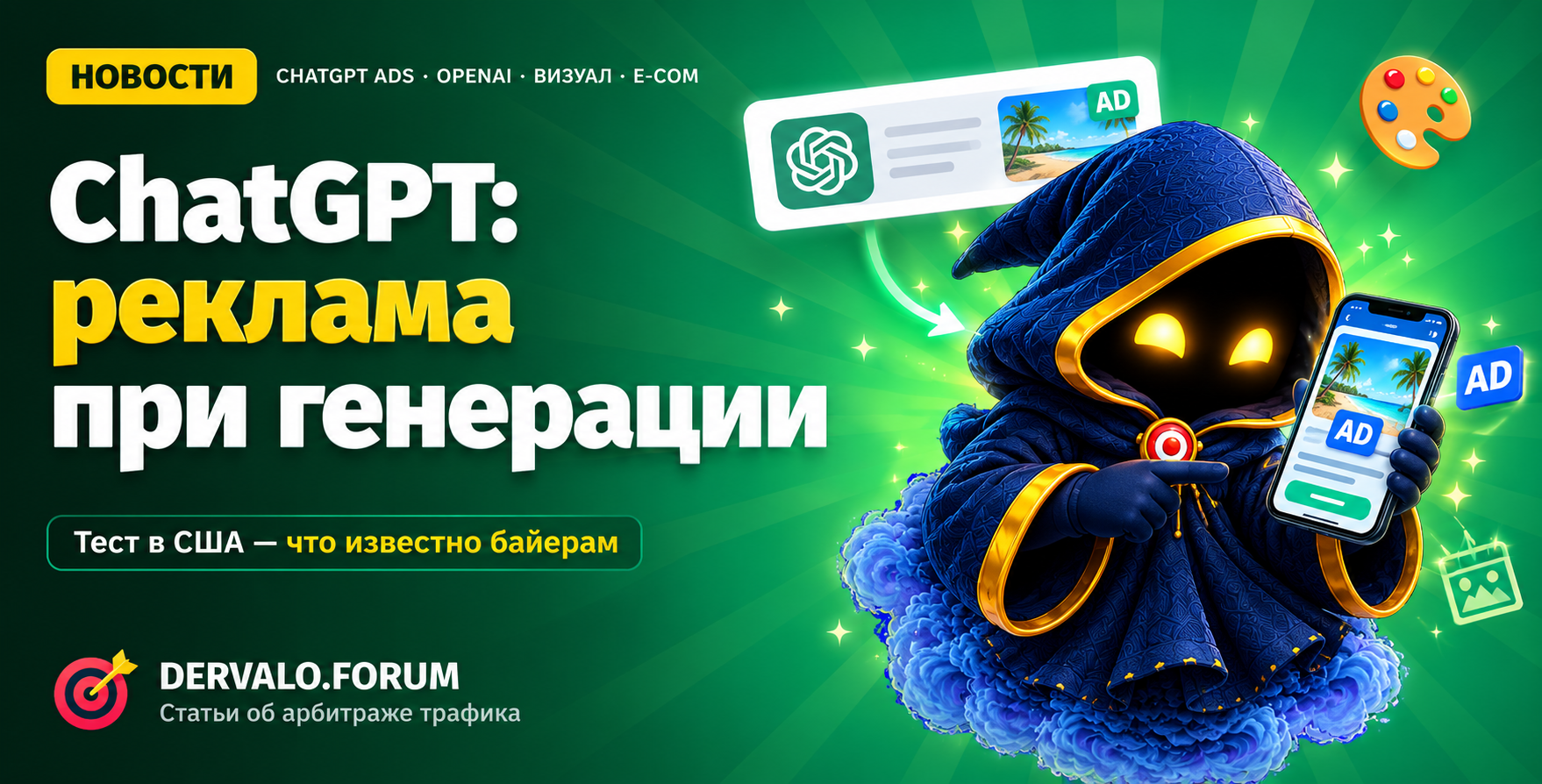
OpenAI is starting to test visual ads in ChatGPT. Later in October, some free users in the US will see a separate ad unit with a product or service image while generating pictures. The company announced it on October 5 and expanded its conversion measurement tools at the same time. Here is how the format works, who it's for and what matters for media buyers.
What the new format looks like
A user asks ChatGPT to create an image, and while it's generating, an ad with an image appears next to it. According to OpenAI, ads will be clearly labeled and remain separate from the image being created — the brand won't end up inside the user's picture.
- Where: in ChatGPT Images, during image generation.
- Who sees it: free users in the US. Plus, Pro and Enterprise subscribers see no ads.
- When: the test starts later in October 2026 with a select group of advertisers.
- What for: showing a product, how it's used or the experience of a service — things that are easier to show than to describe.

What's new here
Ads in ChatGPT are not new. The test started on February 9, 2026: logged-in US users on the Free and Go plans see a labeled sponsored block under the answer. According to Search Engine Journal, early advertisers had to commit at least $200,000, with a CPM of around $60.
What's new is tying the format to a specific action. When someone generates an image, they're already thinking visually, and a product image at that moment feels more natural than a couple of lines of text. This matters most for e-commerce: interiors, fashion, design, travel.
OpenAI stresses again: ads don't affect answers
The company repeats the principle it stated at launch: advertisers can't pay for ChatGPT to recommend their product in an answer. The ad is always separate and labeled. The restrictions from the first test also apply: no ads for users under 18 or in conversations on sensitive topics such as health and mental wellbeing.
The key part for performance: pixel, Conversions API and attribution
Along with the visual format, OpenAI expanded its measurement tools. For media buyers this may matter more than the image itself:
- Pixel and Conversions API to send purchases, leads, installs and sign-ups — essentially the same setup as Meta and TikTok. Docs are already on the OpenAI developer portal.
- Event Quality Score to rate the quality of events you send, plus click-through and view-through attribution windows.
- Attribution and data partners: AppsFlyer, Adjust, Branch, Singular, Kochava, Triple Whale, Northbeam, Hightouch, Tealium, LiveRamp and others. DoubleVerify and Integral Ad Science handle brand safety.
OpenAI also shares early advertiser results: WeightWatchers saw a 15.3% lower cost per acquisition than in paid search, and 93% of Portland Leather's visitors from ChatGPT ads were new customers. These are the platform's own figures; there are no independent measurements yet.
What's allowed and what isn't
For affiliate marketers this is the key point. According to Securities.io, ChatGPT ads exclude gambling and tobacco as well as sensitive contexts. Financial, healthcare and legal services are approved case by case. The main allowed categories are lifestyle goods, local services, travel, digital products and education.
What it means for media buyers
- For now it's a channel for big e-commerce brands. A $200,000 entry threshold and a closed advertiser list rule out solo buyers and small teams. Gambling and betting won't get in at all.
- Prepare visuals, not just copy. If the format rolls out, creatives that show the product in action within a second will win. We covered testing approaches in the article on creatives for affiliate marketing.
- Server-side conversion tracking is becoming the standard. Pixel + Conversions API follows the same logic as other platforms. If you're still losing events, start with the postback error checklist.
- The moment of the impression matters. ChatGPT matches the format to what the user is doing: text next to an answer, an image next to a generation. For buyers it's another factor besides the creative and the bid.
- Run the numbers yourself. A CPM of around $60 is expensive even by Tier 1 Meta standards. Before going in, estimate the CTR and CR you need to break even: formulas are in the article on CTR, CR, EPC and ROI.
What is still unknown
- How much the ad will depend on the content of the image prompt.
- Ad frequency and unit size.
- When the format will be available outside the US and without a minimum budget.
- Whether OpenAI's published results will be independently audited.
All the important ad platform news — in our Telegram channel.
Sources: OpenAI (October 5, 2026 announcement and ChatGPT Ads developer docs), Engadget, Securities.io, Yahoo Finance, Search Engine Journal (ChatGPT ads launch in February 2026). Data checked on October 6, 2026.