


Facebook affiliate marketing is the most popular way into media buying: a huge audience, precise targeting and an algorithm that finds buyers for you. It is also where beginners most often burn their first budget — on bans, poorly structured tests and offers that cannot be advertised. This step-by-step guide shows how to start with Facebook Ads from scratch: budget, tools, choosing an offer, launching your first campaign and the numbers that tell you what to kill and what to scale.
Quick answer
- Starting budget: at least $400–600, comfortably $1,500–2,000 for one GEO and one offer.
- What you need: an ad account (ideally an agency account), an antidetect browser, proxies, a tracker, a domain and 3–5 creatives.
- Where to start: one vertical, one GEO, one offer with a clear conversion — no gambling or aggressive claims at the start.
- How to test: 3–5 ad sets at $10–20 per day, decisions based on numbers.
- Golden rule: if EPC is lower than your cost per click, creatives won't save you — change the offer, GEO or angle.
How Facebook affiliate marketing works
You buy ads and send people to an affiliate offer that pays for an action: a lead, sign-up, deposit or purchase. On Facebook you pay for impressions (CPM) and earn the affiliate payout; profit is the difference. "Facebook" here means the whole Meta ad system — Facebook, Instagram, Messenger and Audience Network — managed from one ad account.
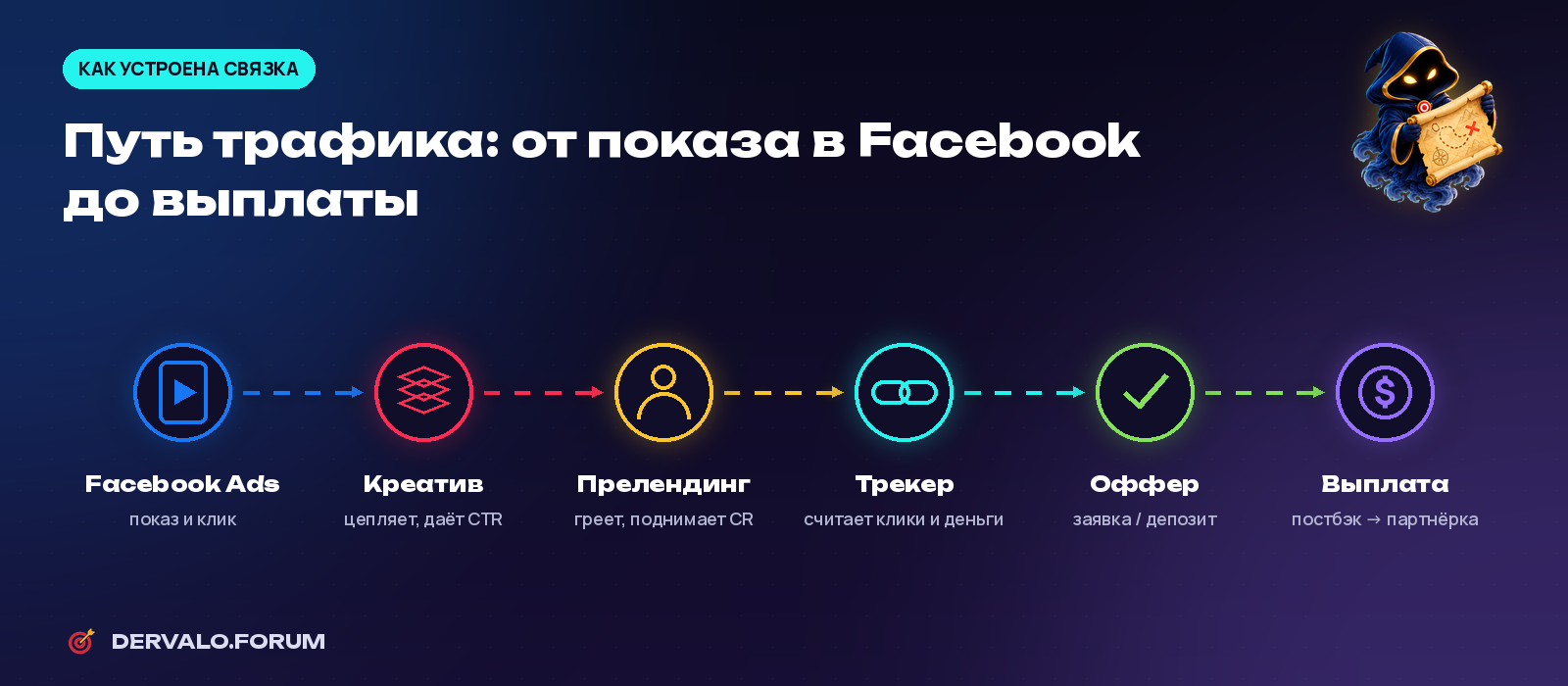
Every step of the funnel affects your final profit
The creative drives click-through rate, the pre-lander drives conversion rate, and the tracker shows where the money comes from. A working combination of all elements is called a setup (funnel).
How much money do you need
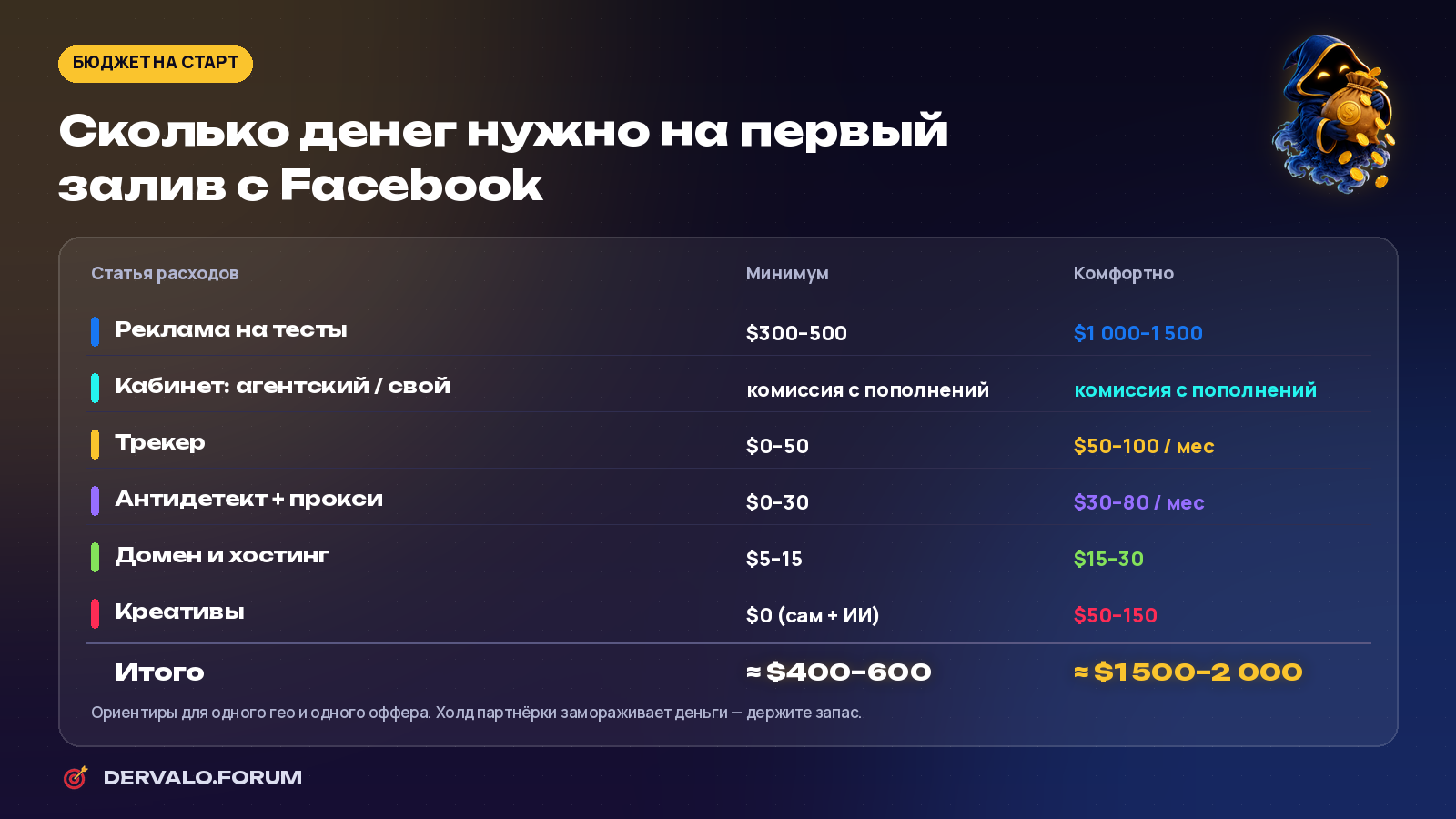
Budget guidelines for your first campaign (chart labels in Russian)
- Ad spend for testing is the main cost: at least $300–500 for one GEO and one offer.
- Hold periods: affiliate networks pay after a hold, so you need working capital while waiting.
- Tools: many antidetect browsers and trackers have free or trial plans that are enough to start.
Unit economics are explained in affiliate math: CTR, CR, EPC and ROI.
Step 1. Choose a vertical, GEO and offer
Start with one vertical and one GEO. Beginner-friendly options: e-commerce products, nutra (pay-per-approved-lead — watch the approval rate and avoid health claims), sweepstakes/SOI offers and lead generation. Postpone gambling and betting: Meta requires prior written permission and a local licence for gambling ads, otherwise ads are rejected and accounts get banned.
When picking an offer, look at average EPC and approval rate, check that Facebook traffic is allowed, and ask your manager about caps and hold. Compare networks in our affiliate program ratings and read about payment models.
Step 2. Prepare your tools
Ad account. An agency account from an official Meta partner is the safest start: higher trust and limits, top-ups through the agency for a commission. See Facebook agency ad accounts. If you use your own account, protect its trust score: no sudden budget or location changes, real payment details, no policy violations. Buying or renting other people's accounts violates Meta's rules and leads to bans.
Antidetect browser and proxies keep multiple accounts isolated: one account — one profile — one proxy. Compare tools in antidetect browsers and proxies for affiliate marketing.
Tracker counts clicks, receives postbacks and shows revenue per ad — see Keitaro vs Binom. Pre-lander on your own domain warms up visitors and often lifts conversion dramatically — see pre-landers explained. Find creative ideas with ad spy tools.
Step 3. Launch your first campaign
- Objective: Sales or Leads, optimized for a conversion event via pixel or Conversions API.
- Structure: ABO (ad set budgets) gives control while testing — see ABO, CBO and Advantage+.
- Budget: 3–5 ad sets at $10–20 per day.
- Audience: start broad by GEO, gender and age; test interests in a separate ad set.
- Creatives: 3–5 different angles rather than five versions of one image.
- Compliance: no guaranteed results, fake news or unauthorized celebrities.
Leave the campaign alone for the first 24–48 hours — frequent edits reset the learning phase.
Step 4. When to kill and when to scale
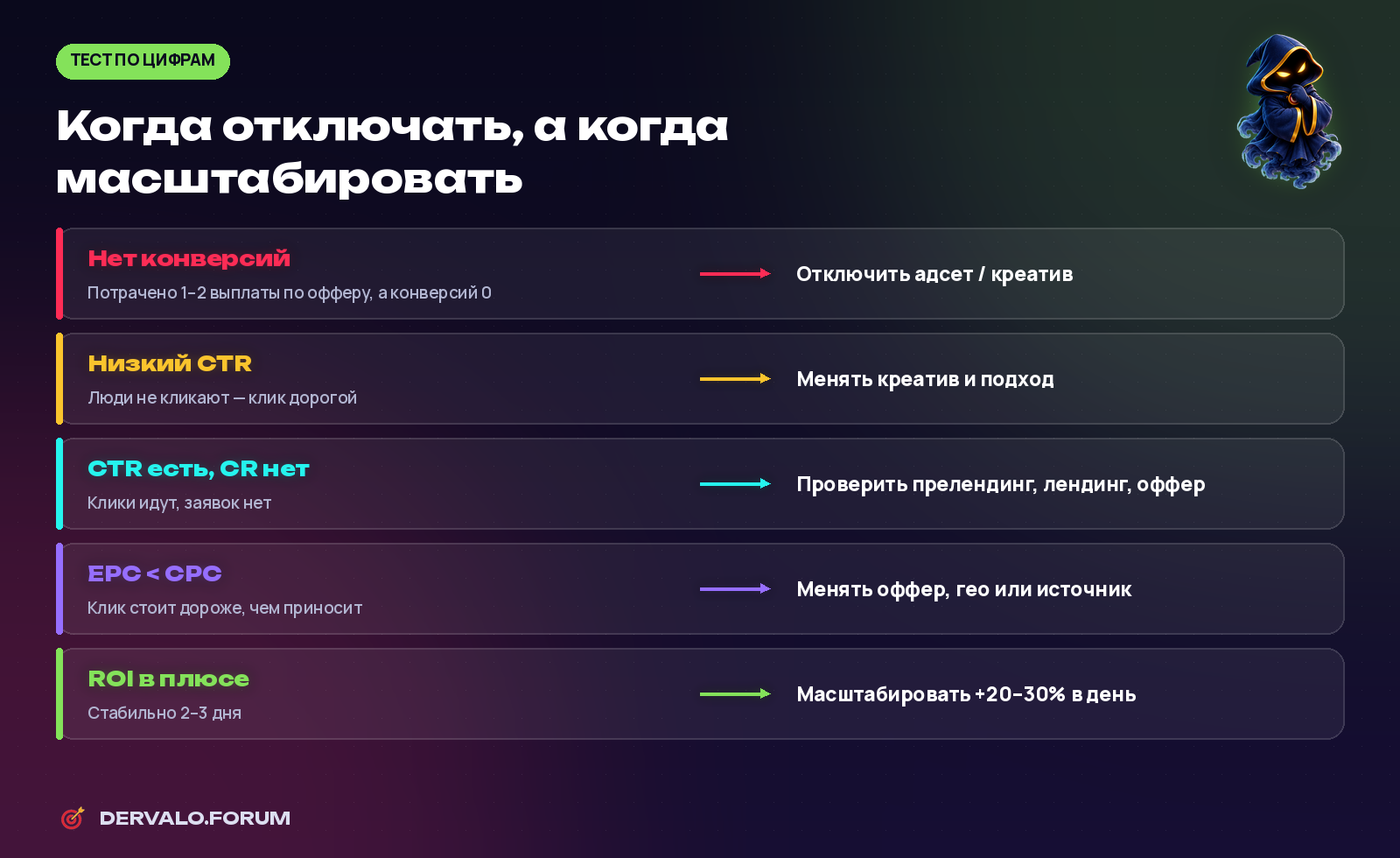
Decisions by numbers (chart labels in Russian)
- No conversions after spending 1–2× the offer payout — turn the ad set off.
- Low CTR — change the creative and angle.
- Good CTR, no conversions — check the pre-lander, landing page and offer.
- EPC below CPC — change the offer, GEO or source.
- Profitable for 2–3 days — scale budgets by 20–30% per day or duplicate the winning ad set.
Example: your first test in numbers
Take an offer paying $20 per approved lead (illustrative numbers). Week 1: $400 spend, CPM $10 → 40,000 impressions, CTR 1.5% → 600 clicks at $0.67, CR 4% → 24 leads, 50% approval → 12 × $20 = $240. EPC $0.40 is below CPC; ROI −40%. Week 2: weak ad sets off, best creatives kept, new pre-lander. $300 spend, CPM $9, CTR 1.8% → 600 clicks at $0.50, CR 6% → 36 leads, 55% approval → 20 × $20 = $400. EPC $0.67 is above CPC; ROI +33%.
The first test is almost always negative — you are paying for data. Profit comes from cutting what doesn't work and doubling down on what does.
Your first 30 days
- Week 1: choose vertical, GEO and offer; set up account, antidetect, proxies, tracker, domain, pre-lander and 5–10 creatives.
- Week 2: test 3–5 ad sets at $10–20 per day, no edits for 48 hours.
- Week 3: cut losing ad sets, iterate on winning creatives, test a second pre-lander.
- Week 4: scale gradually if profitable; otherwise change the offer or GEO, not just the images.
Why Facebook ad accounts get banned
Policy violations, suspicious activity (a new account with a big budget, frequent IP and device changes), payment problems and user complaints. If it happens, read what to do in the first 24 hours after a ban.
Top beginner mistakes
- Launching without a tracker.
- A budget too small to reach statistical conclusions.
- Starting with gambling or other restricted verticals without authorization.
- One creative idea in five variations instead of different angles.
- Editing campaigns during the first day.
- Judging by CTR instead of money.
- No cash reserve for payout holds.
Pre-launch checklist
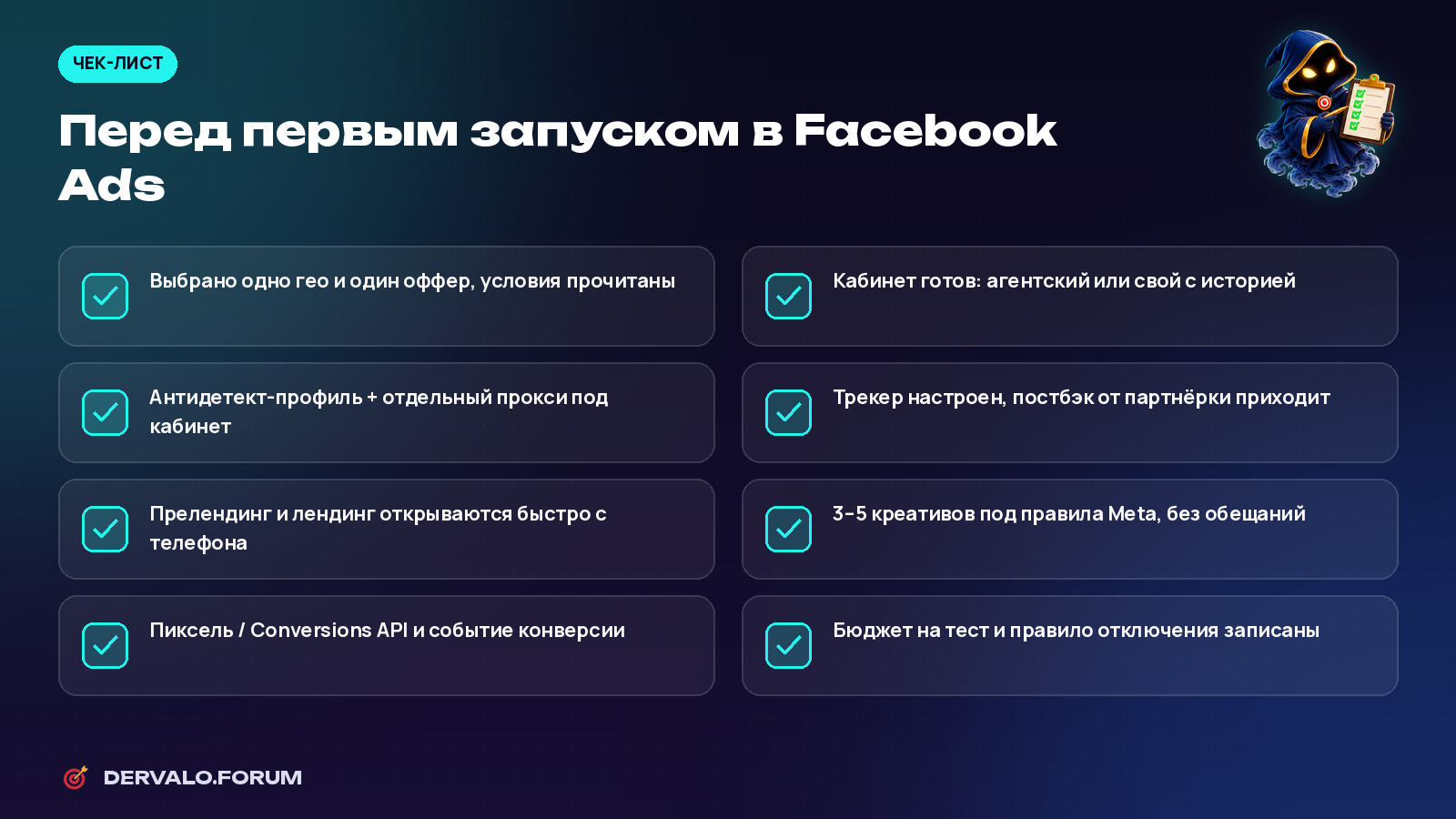
Check before every new launch (chart labels in Russian)
Comparing traffic sources? Read Facebook Ads vs TikTok Ads for affiliates. Questions? Ask on the DERVALO forum.
FAQ
Can I start Facebook affiliate marketing with no money?
No. Facebook ads are paid, and testing needs at least $300–500 in ad spend.
Which vertical is best for beginners?
E-commerce, nutra, sweepstakes or lead generation. Gambling on Facebook requires Meta's permission and a licence.
Do I need a tracker from day one?
Yes — without it you can't see which creative and audience actually convert.
Agency account or my own?
An agency account is safer for beginners thanks to higher trust and limits.