


How to grow a YouTube channel from zero is the question that comes up after your first videos get ten views. The good news: YouTube shows videos not just to subscribers but to every viewer who might like them — so a small channel can get views from its very first uploads. This guide covers how to pick a niche and set up your channel, how the YouTube algorithm works, how to get YouTube subscribers for free, how to grow a channel with Shorts, how many subscribers you need for monetization and how to make money on a YouTube channel.
In short: how to grow a YouTube channel
- Pick a niche where you can make 30–50 videos, and set up the channel before your first uploads.
- Shorts plus long videos is the fastest path: Shorts bring new viewers, long videos keep them and add watch hours.
- Thumbnail, title and the first 30 seconds matter more than tags: YouTube looks at whether people click and whether they keep watching.
- Monetization: from 500 subscribers — memberships and fan funding; from 1,000 subscribers and 4,000 watch hours (or 10M Shorts views) — ad revenue.
- Don't buy subscribers: YouTube removes fake engagement, and a dead audience ruins recommendations.
How YouTube channel growth works: 4 stages
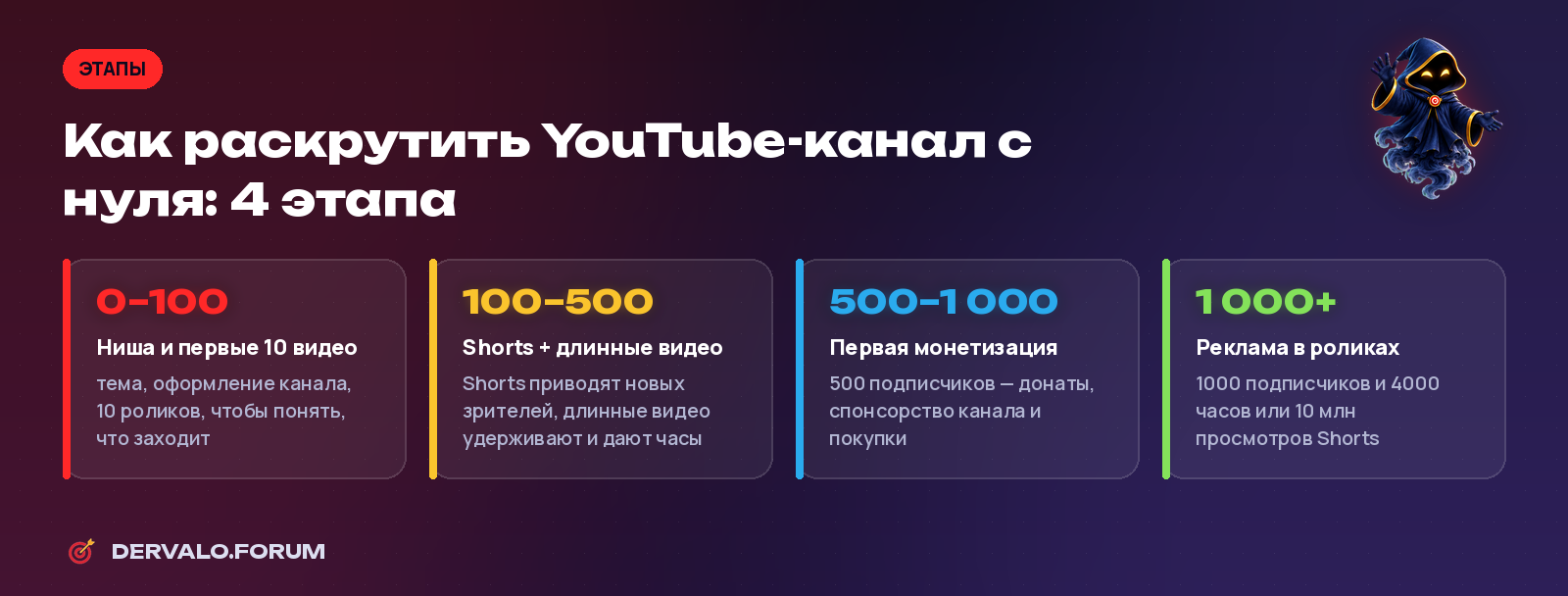
Stages of growing a YouTube channel (chart labels in Russian)
Growing a YouTube channel isn't one "trick" — it's a sequence. Each stage has its own goal:
- 0–100 subscribers. Find a topic that works. Your first 10 videos are a test of niche and format, not an attempt to go viral right away.
- 100–500. Consistency and pairing Shorts with long videos. What matters here is that a viewer who came for one video watches two more.
- 500–1,000. First monetization: channel memberships, Super Chat, Super Thanks. Alongside that — your first affiliate links.
- 1,000+. Ad revenue, sponsorships, your own products and moving your audience to Telegram.
Step 1. Niche: what to make videos about
The most common beginner mistake is a channel "about everything." YouTube recommends videos to people who watch similar content, and a channel without a topic can't find "its" audience. Before you start, answer three questions:
- Do you have enough topics for 30–50 videos? If you only have ideas for five, the niche is too narrow.
- Are people searching for it? Start typing the topic into YouTube search — the suggestions show real queries. Lots of competitor videos with good views is a plus, not a minus: there's demand.
- How will you make money? Tech reviews, finance, education, software and services are easier to monetize with ads and affiliate links than entertainment.
Step 2. Channel setup
- Channel name — short, easy to say, ideally hinting at the topic. "Name + topic" or "topic + a promise word" works better than abstract names.
- Profile picture and banner — readable on a phone. The banner says what the channel is about and how often videos come out.
- Channel description — 2–3 sentences with keywords: YouTube uses it in search.
- Profile links — Telegram, website, social media. The primary link appears right above the Subscribe button.
- Trailer and playlists — a new viewer immediately knows what to watch first.
How the YouTube algorithm works
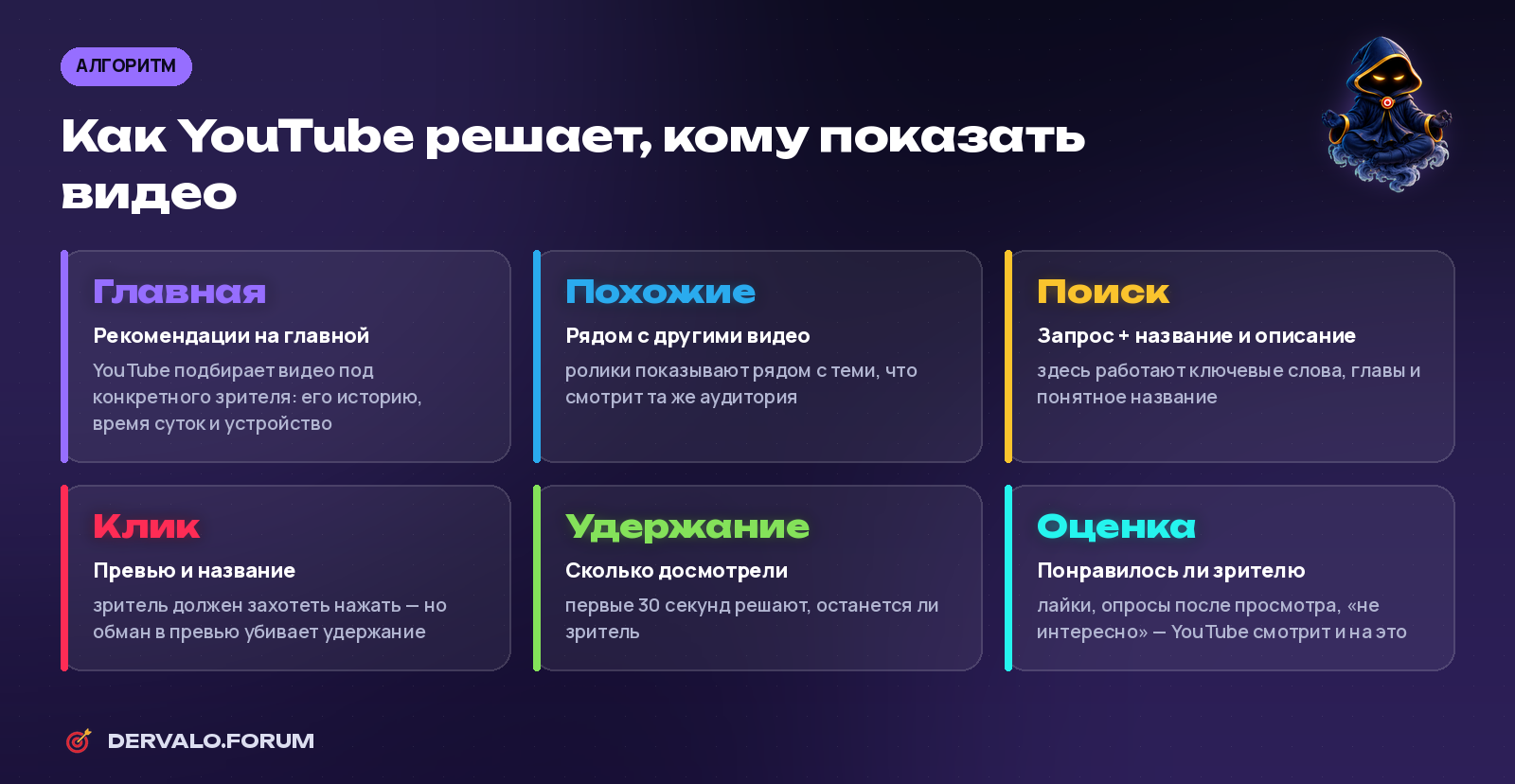
How YouTube decides who sees a video (chart labels in Russian)
The key thing to understand about the YouTube algorithm: it doesn't "push" videos, it matches them to individual viewers. Todd Beaupré, YouTube's director of growth and discovery, describes it as "it isn't so much about pushing it out as much as it's pulling" — the system looks for people who will enjoy a video. Videos reach viewers from several places:
- Home page — personal recommendations based on watch history, time of day and device.
- Suggested videos — next to videos watched by the same audience.
- YouTube search — where keywords in the title, description and chapters matter.
- The Shorts feed — shows videos to people who don't follow you.
How do you get into YouTube recommendations? The algorithm looks at three things: whether people click (thumbnail and title), whether they keep watching (audience retention) and whether they're satisfied (likes, post-watch surveys, "not interested" clicks). According to Beaupré, YouTube tries to understand not just viewer behavior but how viewers feel after watching. That's why clickbait that breaks expectations hurts: people click and quickly leave.
Another feature: videos can take off months later when the topic becomes relevant again. Useful videos keep bringing views for a long time — that's the main difference between YouTube and TikTok or Instagram.
How to get YouTube subscribers for free
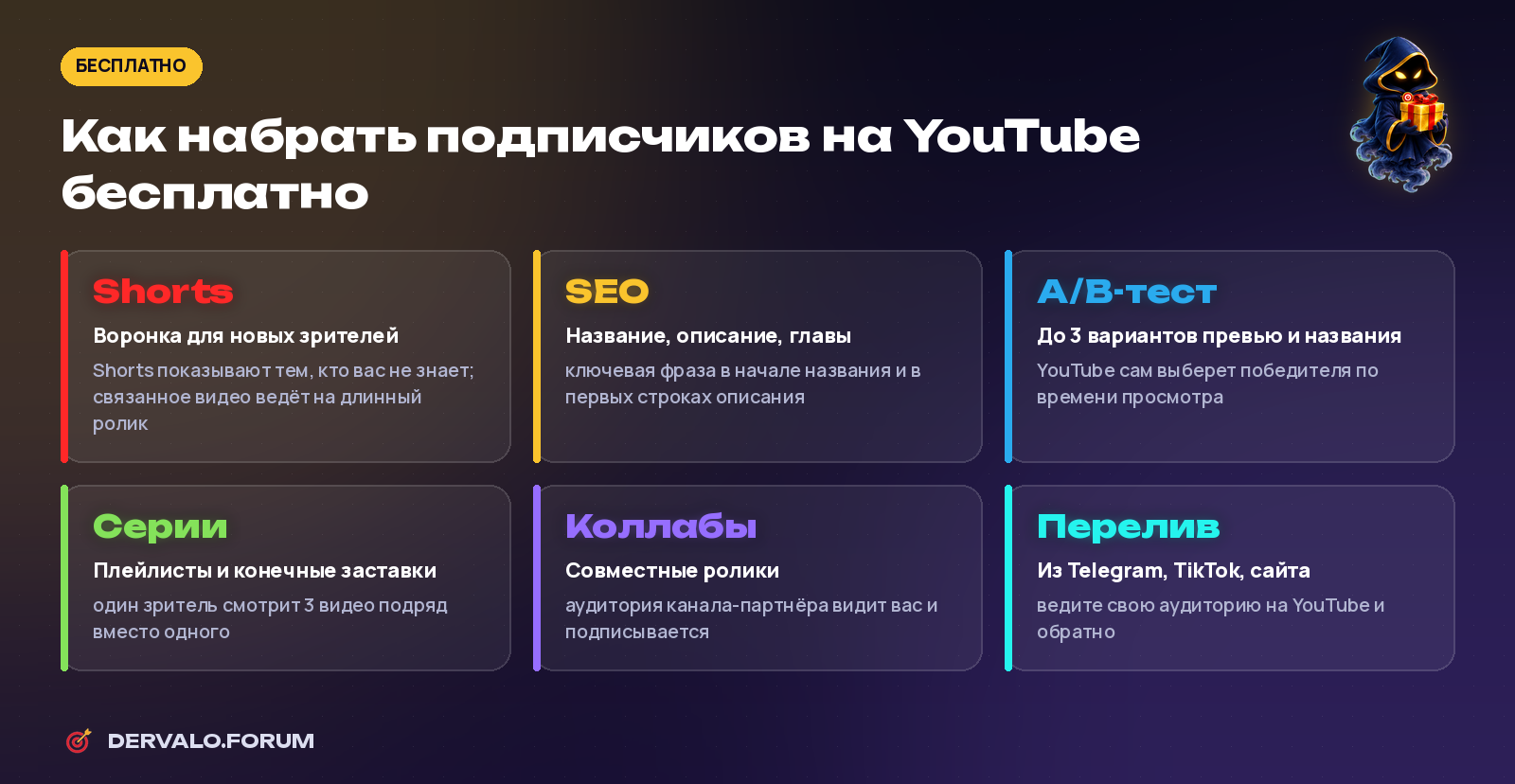
Free ways to get YouTube subscribers (chart labels in Russian)
Growing a channel with Shorts
YouTube Shorts is the fastest way for a new channel to get views. Shorts are shown to people who don't know you, and in 2025 Shorts averaged 200 billion views a day. The setup is simple: a short video delivers value or intrigue, and the related video link (under your handle in the Short) leads to a long video with the details. Shorts can be up to 3 minutes long.
Keep in mind: subscribers from Shorts don't always watch long videos. So make Shorts on the same topic as your main content, not "viral" clips just for the numbers. Which formats work and how to hold attention — in our guide on how to get views on TikTok and Reels: the same rules apply to Shorts.
YouTube video SEO
- Title — the key phrase at the start: "How to Grow a YouTube Channel From Zero: …". Keep it to 60–70 characters so it isn't cut off.
- Description — the gist and keywords in the first 2–3 lines, then timestamps, links and 2–3 hashtags.
- Chapters (timestamps) — help viewers and show up in Google search as separate video segments.
- YouTube tags play a minor role: YouTube itself says tags mainly help with common misspellings. 5–10 relevant tags are enough.
- Captions — check the automatic ones: they help YouTube understand what the video is about.
How to make a YouTube thumbnail
The thumbnail is the first thing a viewer sees. A good thumbnail reads on a phone screen: one idea, 2–4 big words, a face with emotion or the main object, contrasting colors. YouTube Studio has built-in A/B testing: you can upload up to three thumbnail and title variants, and YouTube picks the winner. One important detail: the winner isn't the version with the most clicks, but the one that drives the most watch time.
Audience retention
- The first 30 seconds — get straight to the point: show the result or ask the question the video will answer. Long intros and title sequences are the main reason people leave.
- Structure — a new idea, a cut or an example every 1–2 minutes.
- Analytics — check the retention graph in YouTube Studio: dips show where viewers get bored.
Playlists, end screens and collabs
Your goal is for a viewer to watch three videos in a row, not one. Group videos into topic playlists, add end screens linking to the next video and mention earlier videos in your script. Collaborations with channels of your size and niche give you access to an existing audience — just like cross-promotion on Telegram or collabs on Instagram.
Cross-promotion from other platforms
If you have a Telegram channel, TikTok, website or blog, send that audience to YouTube. Embed videos in articles on your site: they get views from Google too. And the other way round: YouTube can be a source of subscribers for Telegram — more in our article on how to make money on a Telegram channel.
How often to upload to YouTube
There's no official "right" frequency: YouTube doesn't penalize breaks, but consistency helps viewers come back. A realistic start is 1 long video a week plus 3–5 Shorts. Better to upload less often with a strong thumbnail and opening than every day "however it turns out."
How long does it take to grow a channel
The first 1,000 subscribers usually take anywhere from a few months to a year, depending on the niche, frequency and quality. Shorts, a topic with search demand and collaborations speed things up.
Paid YouTube channel promotion
Advertising a YouTube channel makes sense once you have videos with strong retention. Options:
- Google Ads (video campaigns) — ads for your videos on YouTube, targeted by interests and search queries. Where to start — in our article on Google Ads for beginners.
- The "Promote" button in YouTube Studio — a simplified way to run ads right from Studio; not available in every country.
- Creator sponsorships — an integration or shoutout from a creator in your niche.
Track the cost per subscriber and check whether "paid" viewers keep watching your next videos. Cheap views without retention don't help the channel.
Buying YouTube subscribers: why you shouldn't
YouTube explicitly bans fake engagement: bought views, subscribers and likes get removed, and repeated violations can get the channel terminated. Even if nobody notices, it hurts: bots don't watch videos, and YouTube gets a signal that your videos don't interest your own audience. Recommendations stop working.
YouTube monetization: requirements and how to make money
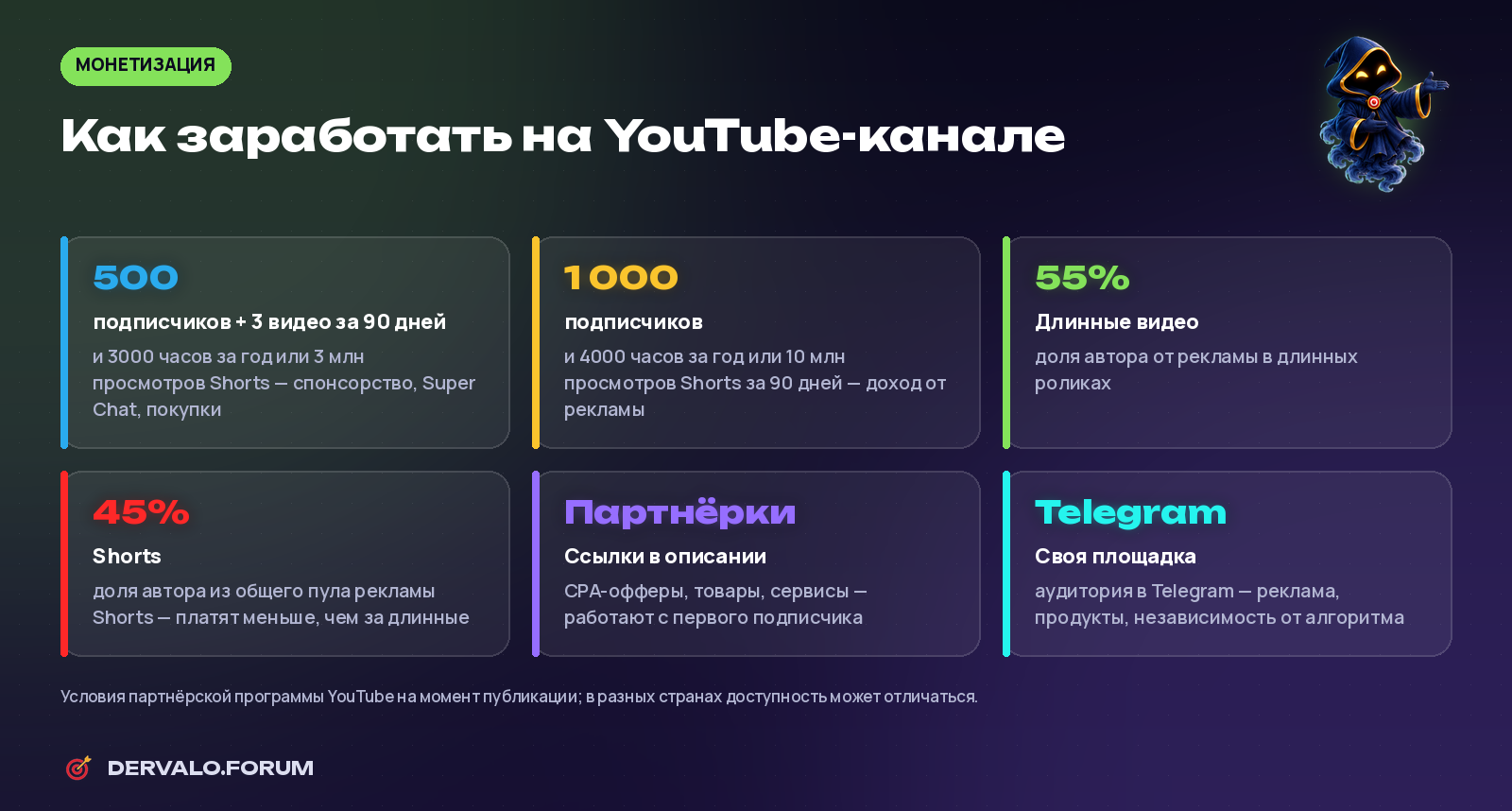
How to make money on a YouTube channel (chart labels in Russian)
How many subscribers you need to monetize on YouTube
The YouTube Partner Program (YPP) has two tiers:
- 500 subscribers, 3 public uploads in the last 90 days and 3,000 watch hours in 12 months (or 3M Shorts views in 90 days) — unlock channel memberships, Super Chat, Super Thanks and YouTube Shopping. This tier isn't available in every country.
- 1,000 subscribers and 4,000 watch hours in 12 months (or 10M Shorts views in 90 days) — ad revenue on your videos.
How much YouTube pays per 1,000 views
There's no single rate. On long videos creators get 55% of ad revenue; on Shorts, 45% of their share of the overall Shorts ad pool. What you actually earn per 1,000 views (RPM) depends on the viewers' country, the topic and the season: finance, tech and business pay more than entertainment, and audiences from the US and Europe pay more than those from the CIS. Shorts pay noticeably less than long videos. You can see your channel's real RPM in YouTube Studio once monetization is on.
How to make money on YouTube Shorts
Beyond the ad revenue share, Shorts drive traffic to long videos, affiliate offers and Telegram. More on monetizing short videos in our guide on how to make money on YouTube Shorts, and which verticals you can promote through Shorts in what to promote on YouTube Shorts.
Other ways to earn
- Affiliate links in the description — work from your first subscriber. A list of vetted programs is in our affiliate program ranking.
- Sponsorships — brands buy mentions from channels with a real audience in their niche.
- Your own product — a course, consulting, templates, a service.
- A Telegram channel — your own platform where your audience doesn't depend on YouTube's algorithm.
Checklist: what to check before publishing

What to check before publishing a video (chart labels in Russian)
A 30-day plan to grow a YouTube channel
- Days 1–3: niche, a list of 30 topics, channel setup, profile links.
- Week 1: 1 long video and 3–5 Shorts on the topic, a related video for each Short.
- Week 2: second video, thumbnail A/B test, first playlist.
- Week 3: retention analysis in YouTube Studio, 2–3 collab pitches to channels in your niche.
- Week 4: repeat the format of your best video, start moving viewers to Telegram or run your first ad.
If you want to earn from traffic, not just your own channel, start with our guide to traffic arbitrage for beginners. New guides on YouTube, TikTok and Telegram in our Telegram channel.
FAQ
How do I grow a YouTube channel from zero for free?
Pick a niche, set up the channel, post long videos and Shorts on one topic, work on thumbnails, titles and the first 30 seconds, build playlists and collaborate with channels your size.
How do I get my first 1,000 subscribers on YouTube?
The fastest path is pairing Shorts with long videos: Shorts bring new viewers, and long videos turn them into subscribers. Add SEO titles that match search queries and post consistently.
How many subscribers do you need to monetize YouTube?
500 for memberships and fan funding (plus 3 uploads in 90 days and 3,000 watch hours or 3M Shorts views), 1,000 for ad revenue (plus 4,000 watch hours a year or 10M Shorts views in 90 days).
Do tags help a video rank?
Barely. According to YouTube itself, tags mostly matter for common misspellings. The title, description, thumbnail and retention matter far more.
Can you buy YouTube subscribers?
Technically yes, but YouTube removes fake engagement and can terminate the channel. Bots also don't watch videos, which ruins recommendations.
Sources: YouTube Help on the Partner Program and fake engagement, Todd Beaupré (YouTube) on the recommendation system, Search Engine Journal (title and thumbnail A/B testing, 200 billion daily Shorts views), vidIQ. YouTube's terms change — check the current help pages.