




Traffic arbitrage (performance affiliate marketing, media buying) is earning the difference between what you pay for traffic and what affiliate programs pay you for it: you buy traffic — or get it for free — send it to an advertiser's offer and get paid for every target action: a sign-up, a lead, a purchase or a deposit. This beginner's guide explains what traffic arbitrage is in plain words, how it works, how much affiliate marketers really make, which verticals and traffic sources to pick and how to start affiliate marketing from scratch — step by step, with tools and without $1,000 courses.
Quick summary: affiliate marketing for beginners
- The idea: buy traffic cheaper, sell user actions for more. Profit = affiliate payouts − ad spend.
- Who pays: the advertiser, through an affiliate program or a CPA network — per lead, deposit or sale.
- How much people make: beginners often break even in the first months, a media buyer on a team earns $800–3,000, a solo buyer with a working funnel $1,000–5,000+, teams $10,000+ a month.
- Where to start: a simple vertical (dating, nutra), one traffic source, a CPA network with a low minimum payout, a tracker and a small test budget.
- No money? Start with free traffic — TikTok, YouTube Shorts, Telegram, SEO.
What is traffic arbitrage in plain words
Imagine you buy $100 worth of Facebook ads and send 20 people to an online school's website, where they all submit a lead form. The school pays $8 per lead — you receive $160. The $60 difference is your profit. That is traffic arbitrage: you don't sell your own product, you make money because you can bring customers cheaper than the advertiser is willing to pay for them.
The person doing this is called an affiliate, a media buyer or a publisher. The advertiser is a company that needs customers: a casino, a sportsbook, an online store, a dating service, a broker. Between them sits an affiliate program or a CPA network: it gives the affiliate a tracking link, counts conversions and pays out.
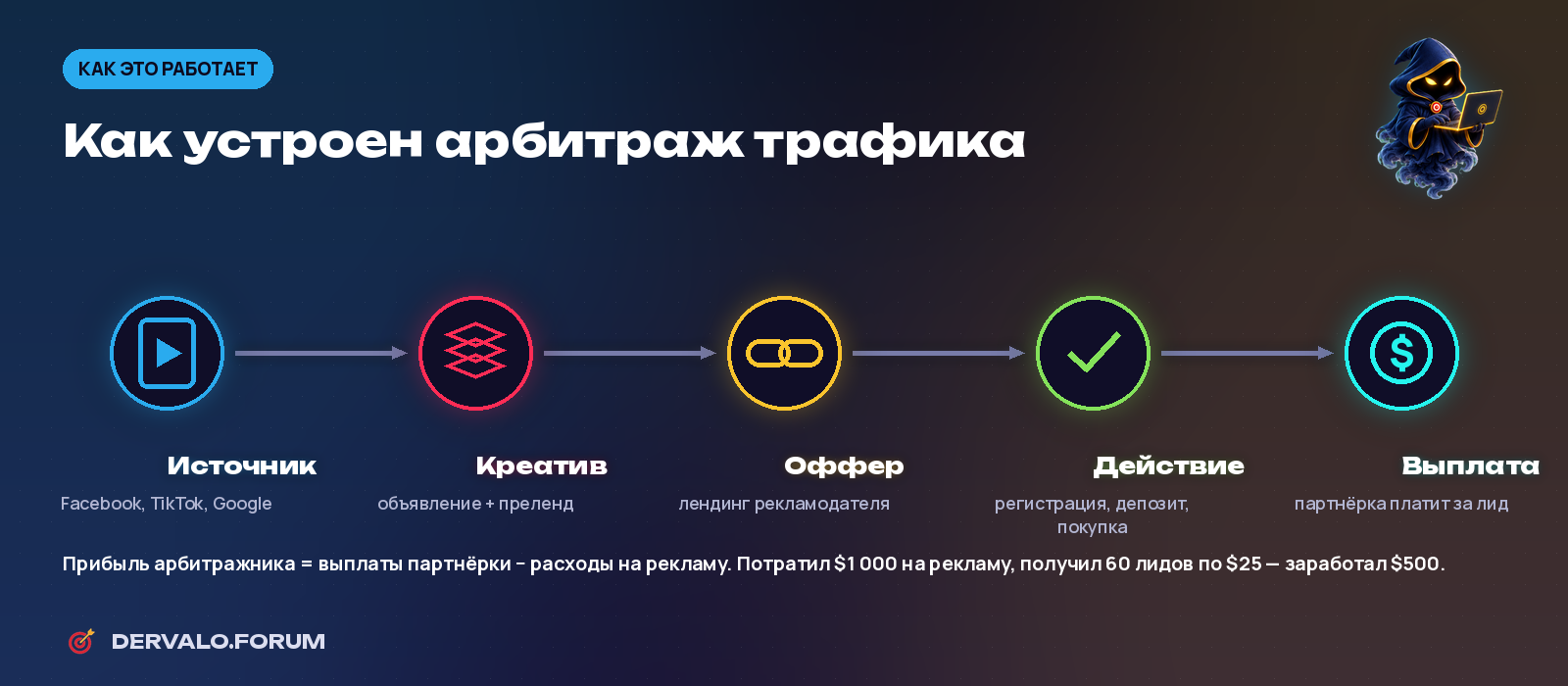
The arbitrage chain: from traffic source to payout (chart labels in Russian)
The full chain looks like this: traffic source → creative (the ad) → pre-lander and landing page → target action → the affiliate program records the conversion → payout. The affiliate's main job is to find a funnel: a combination of source, creative, offer and GEO where revenue is consistently higher than spend.
How affiliate marketing differs from running ads for clients
- An ads manager sets up campaigns for a fixed fee and never risks their own money. An affiliate spends their own budget and keeps all the profit — or takes the whole loss.
- A marketer promotes one brand for a long time. An affiliate freely picks offers, verticals and GEOs and switches as soon as a funnel stops paying off.
- Affiliate marketing is the broader term: it includes bloggers with affiliate links and SEO sites. Traffic arbitrage is the part where traffic is mostly bought.
Payout models: what affiliates get paid for
- CPA — a flat fee per action: a casino deposit, a purchase, an app install.
- CPL — per lead or sign-up: dating, sweepstakes, finance.
- CPS — a percentage or flat fee per sale: e-commerce.
- RevShare — a share of the advertiser's revenue from your users, often for life: gambling, betting, crypto.
- Hybrid — CPA plus a smaller RevShare.
Beginners find CPA and CPL easiest: money comes fast and ROI is simple to calculate. More in payout models in affiliate marketing.
How much do affiliate marketers make
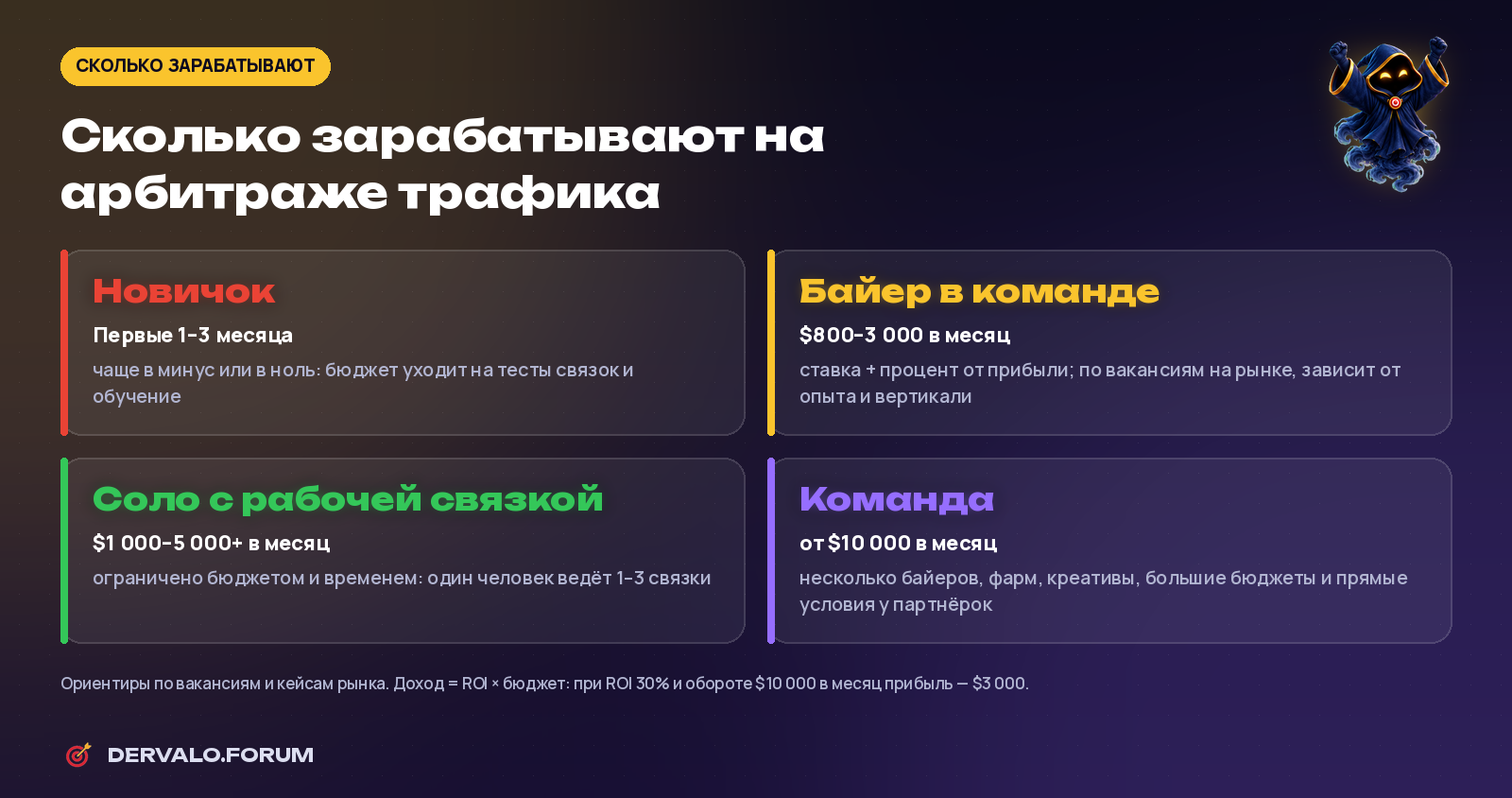
Income benchmarks by level — from beginner to team (chart labels in Russian)
The honest answer: anywhere from a loss to tens of thousands of dollars a month. There's no salary in affiliate marketing — there's ROI and budget. A 30% ROI on $1,000 of monthly spend is $300 in profit; on $30,000 it's $9,000. Income grows with the budget you can push through a profitable funnel.
- Beginner, first 1–3 months. Usually zero or a loss: the budget goes into tests, account bans and mistakes. That's the normal price of learning — just keep it small.
- Media buyer on a team. Based on job listings — a $800–3,000 monthly base plus a share of profit. The team supplies budget, accounts and proven funnels; you supply the work.
- Solo affiliate with a working funnel. $1,000–5,000+ a month. Capped by one person's time and budget.
- Team. $10,000+ a month: several buyers, account farming, creative producers, big budgets and direct deals with programs.
How to calculate your own numbers — CTR, CR, EPC, ROI — is covered in media buying math. The key point: it's not the biggest budget that wins, it's whoever finds and scales profitable funnels fastest.
Verticals: where to send traffic
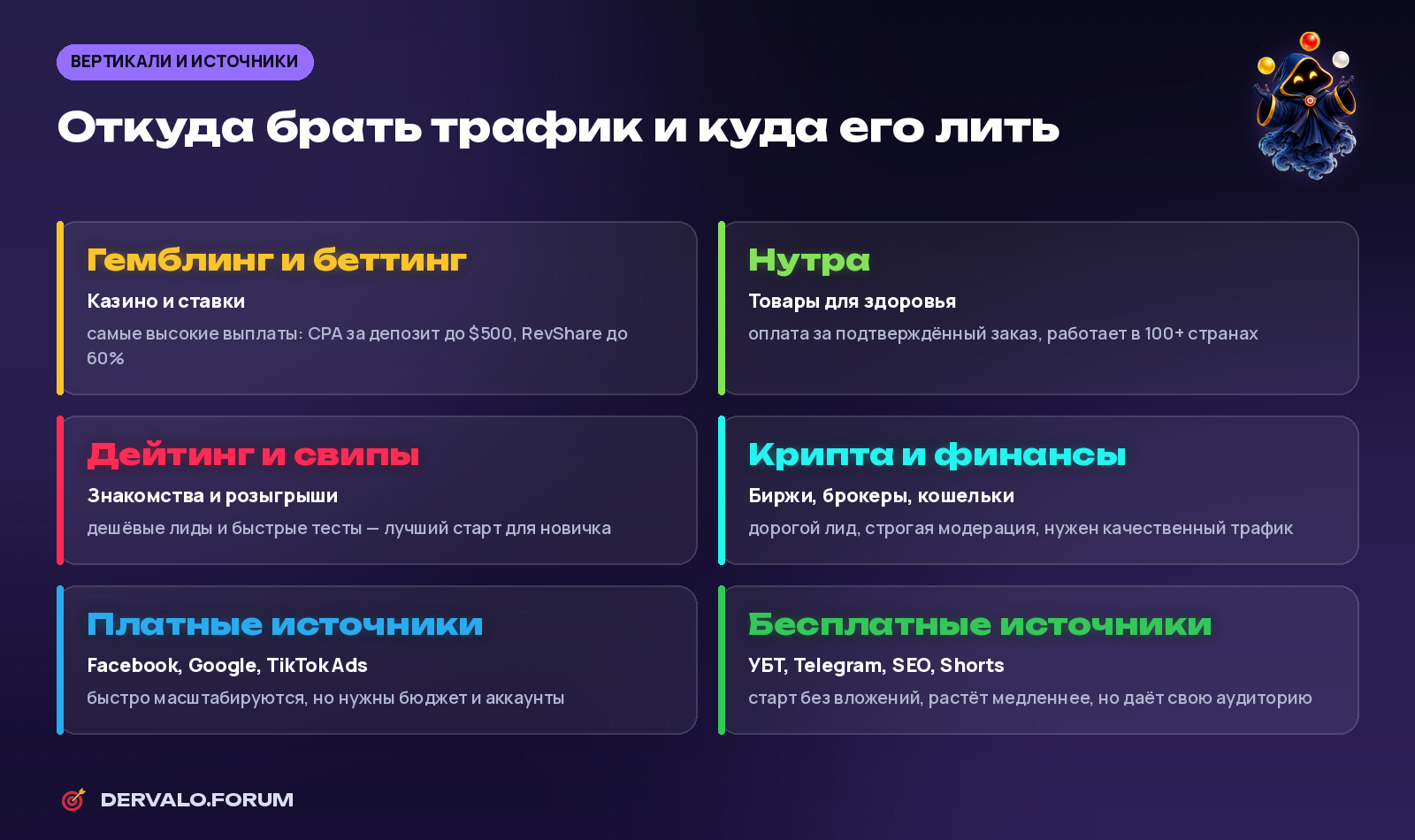
Verticals and traffic sources: what to pick as a beginner (chart labels in Russian)
A vertical is the offer's niche. It determines payouts, moderation difficulty and the budget needed for tests.
- Gambling and betting — casinos and sportsbooks. The highest payouts: CPA per first deposit up to $200–500, RevShare up to 60%. But you need budget, a cloaker and experience: gambling ads don't pass moderation directly. See our top 10 gambling affiliate programs.
- Nutra — health and beauty products paid per confirmed order. Works in 100+ countries with plenty of ready landing pages.
- Dating and sweepstakes — cheap leads, fast tests, smartlinks — the best start for a beginner.
- Crypto and finance — exchanges, brokers, wallets. Expensive leads, but strict moderation and traffic quality requirements.
- E-commerce — physical products and stores, paid per sale.
Traffic sources: where to get traffic
A traffic source is where your users come from. Sources are paid or free.
- Facebook and Instagram Ads — the main source in affiliate marketing: huge audience and precise targeting, but strict moderation and bans. Start with Facebook media buying from scratch.
- Google Ads — hot search traffic, expensive clicks, strict rules.
- TikTok Ads — cheap reach and a young audience; video creatives work well.
- Push, native and teaser networks — cheap traffic for nutra, dating and sweepstakes, starting from $50–100.
- UBT (free organic traffic) — TikTok, Reels and Shorts videos that lead to Telegram or an offer. Start with no budget — see UBT via YouTube Shorts and Reels.
- Telegram — your own channel as a traffic source: how to grow a Telegram channel from zero and how to make money on it.
- SEO — your own sites for search queries: slow, but the traffic is almost free afterwards.
Advice for beginners: one source and one vertical. Until you understand how a funnel works on one platform, spreading across three is the surest way to burn your budget.
The affiliate's toolkit
The minimum stack for paid traffic:
- Tracker — counts clicks, conversions and ROI per creative and receives postbacks from the program. Without it you don't know what makes money. See trackers for media buying; many have free plans.
- Antidetect browser and proxies — to run several ad accounts without getting them linked and banned. Reviews: top 5 antidetect browsers and proxies for media buying.
- Cards or an agency account — to pay for ads. What to do when Facebook rejects your card.
- Spy tool — a database of competitors' creatives and landing pages: see what already works and make your own version. Top 5 spy tools.
- Cloaker — for grey verticals: shows moderators a white page and users the offer. Cloakers for media buying.
All tools with prices and reviews are in our affiliate tools catalog.
How to start affiliate marketing from scratch: step by step
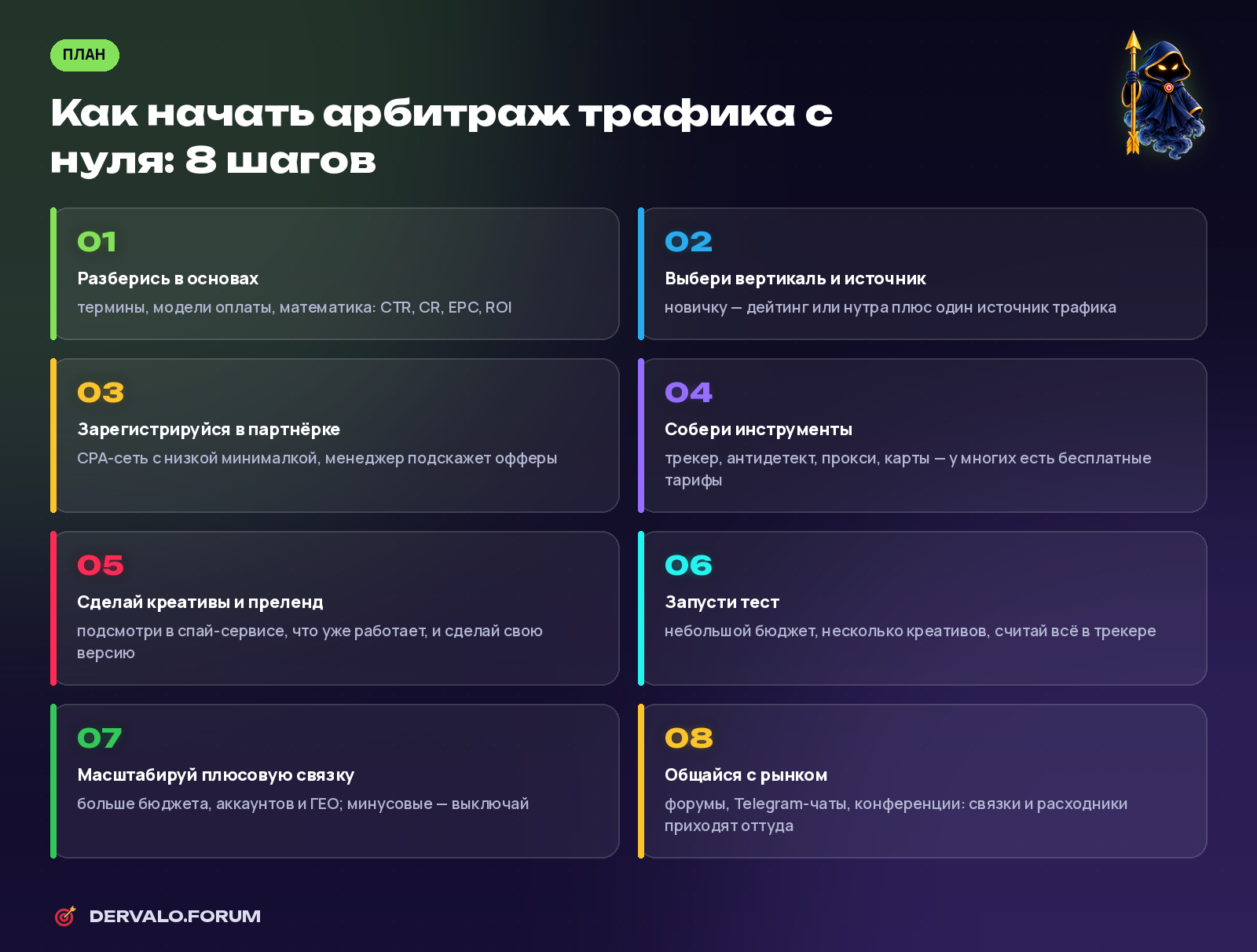
Starter plan: from basics to scaling (chart labels in Russian)
- Learn the basics. Terms, payout models, metrics. Our article on media buying math covers the fundamentals in an evening.
- Pick a vertical and a source. Beginners — dating or nutra and one source: Facebook, TikTok or push networks. Or UBT if you have no budget.
- Join an affiliate program. A CPA network with a low minimum payout and a responsive manager. How to choose — how to choose a CPA network; terms — in our affiliate program catalog.
- Set up your tools. Tracker, antidetect, proxies, cards. Free plans are enough to start.
- Make creatives and a pre-lander. Check a spy tool for what competitors run and make your own version — not a copy.
- Launch a test. A small budget, 3–5 creatives, one audience. Count everything in the tracker, not in your head.
- Scale the profitable funnel. More budget, accounts and GEOs. Kill losing funnels without mercy.
- Talk to the market. Forums, Telegram chats, conferences: new funnels, accounts and program deals show up there before they reach articles.
How much money do you need to start
A minimum test budget for paid traffic is $300–500: for consumables (accounts, proxies, cards) and 5–10 funnel tests. With $100 you can try push or teaser networks. With no money at all — start with UBT and Telegram: free traffic grows slower, but you learn on real numbers without risk. You don't need $500–1,000 courses: the basics are free on forums, in affiliate program blogs and from CPA network managers.
Beginner mistakes
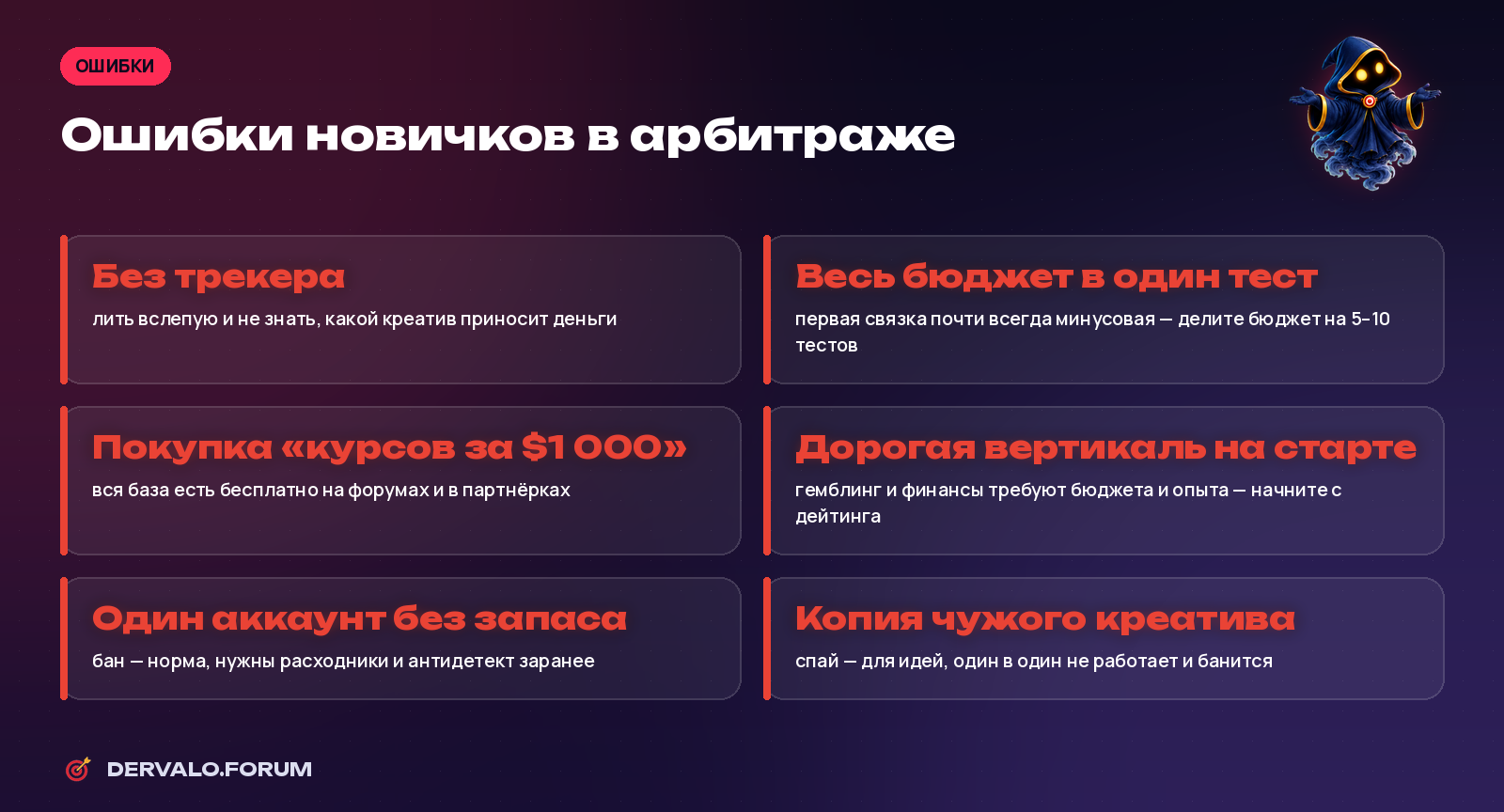
Six mistakes that burn the first budget most often (chart labels in Russian)
- Running traffic without a tracker — and not knowing which creative makes money.
- The whole budget in one test. The first funnel almost always loses. Split the budget into 5–10 tests.
- An expensive vertical at the start. Gambling and finance need experience, budget and a cloaker.
- One account with no backup. Bans are normal. Have accounts and an antidetect ready — see ad account trust.
- Copying someone's creative one-to-one. Spy tools are for ideas; copies get banned and don't convert.
- Quitting after the first loss. Affiliate marketing is a series of tests, not a single launch.
We discuss new funnels, case studies and accounts on the forum and in our Telegram channel.
FAQ
What is traffic arbitrage in simple terms?
Buying traffic in one place and sending it to an advertiser's offer that pays for user actions. The profit is the difference between payouts and ad spend.
How much do affiliate marketers make?
From zero for beginners to $10,000+ a month for teams. A media buyer on a team earns $800–3,000 plus a share, a solo buyer with a working funnel $1,000–5,000+. Income depends on ROI and budget.
Can you start affiliate marketing with no money?
Yes — with free traffic: TikTok, YouTube Shorts, Reels, Telegram, SEO. Paid traffic needs a test budget of $300–500.
Which vertical is best for beginners?
Dating, sweepstakes or nutra: cheap leads, fast tests, easy moderation. Gambling and finance come after your first experience.
Is traffic arbitrage legal?
Arbitrage itself is ordinary marketing. Legality depends on the offer, GEO and methods: advertising unlicensed casinos, misleading users and bypassing platform rules can violate ad network policies and local laws.
Do I need to buy an affiliate marketing course?
No. The basics, tools and programs are documented for free — including on this forum. The best training is your first test on a small budget.
Is an affiliate the same as an ads manager?
No. An ads manager runs campaigns for a client's fee; an affiliate invests their own money and earns the difference.
Income ranges are benchmarks from job listings and market case studies, not guarantees. 18+ content.